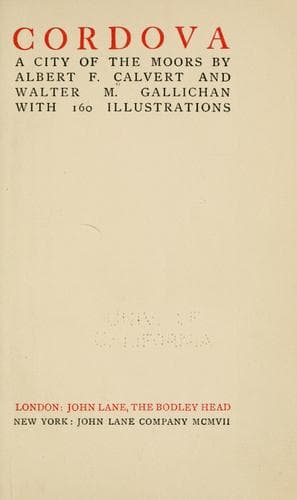
Cordova: A city of the MoorsCalvert, Albert Frederick
History
Cordova: A city of the Moors
Calvert, Albert Frederick
Arabs -- Spain; Córdoba (Spain) -- Description and travel; Córdoba (Spain) -- History
When Abd-er-Rahman I. seized upon the citadel of the Gothic Christian
kings, he found the Cordovese split up into various sects, such as the
Gnostics, Priscillianists, Donatists, and Luciferians. These cults were,
however, united in their detestation of the new creed of the East, which
the victors sought to impose upon them. It is quite clear from the
records of the more impartial Spanish historians, that the Sultan was a
man of tolerant mould and a respecter of justice. His ambition was to
erect a temple, which would rival in magnificence those of Baghdad,
Jerusalem, and Damascus, and approach in sanctity to the fane of Mecca
itself.
The Christian church in Cordova stood upon the site of the former Roman
religious edifice dedicated to Janus, and upon this situation
Abd-er-Rahman desired to rear his great mosque. Autocrat though he was,
the monarch strove to maintain the conditions upon which the
inhabitants had surrendered. He might have broken faith, and annexed
the Christian building and the ground upon which it stood. But he
honourably offered to buy the church and the plot from the conquered
people. The negotiations of purchase were placed in the hands of the
Sultan’s favourite secretary, Umeya Ibn Yezid.
At first the Christians refused to sell their cherished basilica, which
had been divided into a temple of the faith of Christ and a fane for the
worship of Allah. Here, in separate portions of the building, the
conquerors and the conquered murmured their prayers and repeated their
praises to their deities. How the Cordovese were induced to relinquish
the church cannot be explained by any historical evidence that we are
able to obtain from the writings of Arabians and Spaniards. Some authors
have suggested that the Christians of Cordova were disheartened by
adversity and the assaults of Islam upon their creed, and that they
yielded to the suasion and counsels of Umeya Ibn Yezid, and sold their
tabernacle to the invaders. At any rate it is manifest that
Abd-er-Rahman won in the end, and that he was able to forward his
project without showing violence to the natives of Cordova.
Public-domain text, read in full here on John Shaqi.
Reviews
Reviews
No reviews yet
Be the first to share your thoughts on this work.
Join the Discussion
Join the discussion
Sign in to leave a comment or review.
Sign InorCreate an account