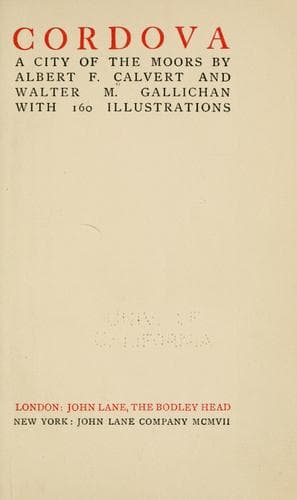
Cordova: A city of the MoorsCalvert, Albert Frederick
History
Cordova: A city of the Moors
Calvert, Albert Frederick
Arabs -- Spain; Córdoba (Spain) -- Description and travel; Córdoba (Spain) -- History
But the pendulum swung again; the dominion of Islam was threatened by
enemies within and without. History repeated itself; Time worked its
inevitable revenge, and a lustier race made profit from the decadence of
the Morisco civilisation. Spain arose and turned upon her oppressor,
and the streets of Cordova were once more drenched with the blood of
Moor and Christian. This proud Bell Tower stands as a symbol of the
reconquest, and of the decline of Cordova.
Christian Spain rejoiced in her change of fortune. The crusaders set
themselves to demolish and to upheave. They abandoned the wholesome
habits of the Moors; the baths were destroyed by the hundred as useless
relics of the detested Mohammedan. Temples, colleges, and palaces were
thrown down. Science, the arts, and letters were neglected. We have read
how trade forsook Cordova, and how the light of learning was almost
extinguished. Gone were the cultured days of Abd-er-Rahman III., and the
resplendent pomp of Almanzor. The Mecca of the West had fallen; the fate
of Roman Corduba had come upon it. There was no revival, no uprising of
the ruins from the ashes that could remake Cordova in the semblance of
its old self. Vestiges alone remained to remind the beholder of the
grandeur and the glory of the Mohammedan domination. A misdirected
imperialism, an irrational conception of greatness, wrought the wreckage
of the ‘Bride of Andalus’ after her recapture by the Christian
Spaniards.
VI
THE SPLENDOURS OF THE MOSQUE
Before the rise of Mahomet, the architecture of the Arabs was almost
devoid of those specific characters that we find in the later work of
Omeyyad designers and artists. The pristine Arabian edifices were built
as though the tent served as the model for the architects of this
nomadic race. But in the great Mosque of Omar at Jerusalem we have the
first example of a new and vigorous development of the art of
architecture. The minaret, or praying-tower, was invented by Alwalid,
and other distinctive features of the Moorish or Saracenic style were
introduced in religious buildings.
Public-domain text, read in full here on John Shaqi.
Reviews
Reviews
No reviews yet
Be the first to share your thoughts on this work.
Join the Discussion
Join the discussion
Sign in to leave a comment or review.
Sign InorCreate an account