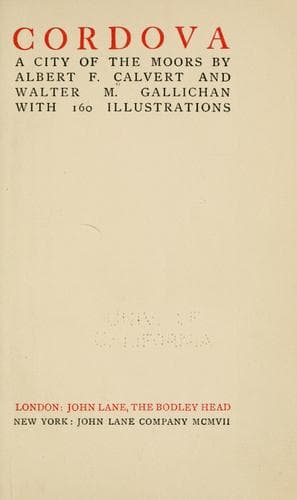
Cordova: A city of the MoorsCalvert, Albert Frederick
History
Cordova: A city of the Moors
Calvert, Albert Frederick
Arabs -- Spain; Córdoba (Spain) -- Description and travel; Córdoba (Spain) -- History
The hollowed roof of the mih-rab and the floor are of white marble. We
may see the marks worn by the knees of the faithful who came hither to
pay their devotions to the Father of Islam. The mosaics of the walls
exhibit the finest designs and richest tones of the _foseyfasa_ work.
This is the third mih-rab, the production of Hakem, and it is a retreat
that speaks eloquently of that piety which seeks to glorify a deity by
the erection and adornment of a temple. It is resplendent beyond
compare.
This chamber was the repository of the famous _nimbar_, a pulpit on
wheels, which had seven steps, and could be moved to any part of the
Mosque. When the Christians regained power in the city, this highly
ornamented pulpit was cut into pieces, and portions of it were used in
the construction of the altar. The superb copy of the Koran, to which we
have referred before, was kept in a golden case, mounted with precious
stones. It was so heavy that two men were required to carry it.
Upon the ceiling of the Mezquita there were formerly inscriptions. Among
them were the command: ‘Be not one of the negligent,’ and the dictum:
‘There is no God but Allah, to whom all beings address themselves in
their need.’ The Christians effaced these inscriptions when the Mosque
was purified and consecrated to the Virgin Mother.
In the Capilla de Villaviciosa we shall see the Arab-Byzantine crossed
arches on decorated columns. This was the retreat of the Khalif, and it
was once lined with silver. The chapel is the only one of Moorish
interest. There are forty-five Christian chapels, but these scarcely
demand inspection. In front of the Capilla of San Pablo is the tomb of
Pablo de Céspedes, the Cordovese painter. This chapel has a horseshoe
arch with sharp points. The Capilla de la Cena contains ‘The Last
Supper,’ painted by Céspedes. And in the Sala Capitular were statues by
Alonso Cano and de Mora.
The chapels were constructed from the side aisles of the Mezquita when
the building was dedicated to the Christian faith. After the capture of
Cordova by San Fernando, the original work of the Moorish builders was
spoiled in many parts of the Mezquita. Large surfaces, beautifully
designed and coloured, were removed by the innovators, columns were
pulled down, and screens destroyed. ‘The gold lavished on the panelled
ceilings,’ so praised by an Arab poet, was obliterated in many places;
the Christian architects wrought havoc in almost every part of the
structure. No doubt the pious reconstructors were unconscious of their
vandalism. They sought to improve upon the art of the Mohammedans, and
to build a worthier edifice. But their failure is only too apparent, and
it has been admitted by Spanish writers. Charles V. expressed sorrow at
the garish and meagre innovations, saying that the designers and
craftsmen had destroyed a great and unique work of art in their
endeavour to improve upon the design of the Moriscos.
VII
THE CATHEDRAL AND CHURCHES
Public-domain text, read in full here on John Shaqi.
Reviews
Reviews
No reviews yet
Be the first to share your thoughts on this work.
Join the Discussion
Join the discussion
Sign in to leave a comment or review.
Sign InorCreate an account