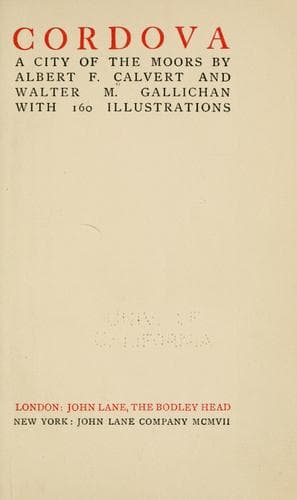
Cordova: A city of the MoorsCalvert, Albert Frederick
History
Cordova: A city of the Moors
Calvert, Albert Frederick
Arabs -- Spain; Córdoba (Spain) -- Description and travel; Córdoba (Spain) -- History
He will pace the silent square at night, and discourse with Seneca. His
ears will drink in the stoic counsels of Lucan, and his brain will
grapple with the problems laid down by the sagacious Averroes. He will
hear the Moslem call to prayer, and stand to gaze upon the band of the
devout filing into the Mezquita.
Clamours of battle will assail him, the clash of sword and shield will
startle his slumber, and the night will tremble with the triumphant roar
of the fierce, invading Goths. And in hours, fragrant with the scent of
flowers--placid in contemplation of the simple happiness of Cordova’s
youths and maidens in the Court of Oranges--he will weave romances of
the ancient life, when the town was the seat of the cultured, the home
of the arts, and the sanctuary of the pious.
Doubtless the Cordova of to-day subsists like other towns upon the
industry and the commercial energy of its inhabitants. There are shops
and hotels in the streets; there are signs of handicrafts and of common
daily employments. But there is no bustle, no indication of a strenuous
existence for the people, and the siesta is long and undisturbed. There
is a market, but its produce and merchandise do not suggest the wealth
and commerce of earlier days. The _consumo_, or customs officer, levies
his tax upon almost everything which the hard-faring peasants bring into
the town, and we have seen a conflict between one of these officials and
a countryman over a single live pigeon. The peasant questioned the tax,
and the officer explained the case with the flat of his sword-blade.
This incident is characteristic of Andalusia, and perhaps it may throw a
light upon the discontent which is apt, at times, to manifest itself
violently among the agricultural population of Spain.
Certainly there are days of markets and ferias when Cordova arouses
itself, and trains of mules and asses creep into the place, and flocks
may be seen in the streets. Wine, oil, and fruit are produced in the
environs, and grain-crops flourish on the plain. In mediæval times
Cordova was famed for its mart, where silk and grain were sold. The
district still bears repute for its horse-breeding, but the stock has
suffered deterioration through injudicious selection. An anonymous
American writer, who was here in 1831, speaks of the horses of Cordova
as the finest in Spain, and asserts that they are the descendants of the
pure Arabian breed. One still notes many good horses. It is said that
the water from the Guadalquivir is as nourishing for horses as is the
barley of certain districts of Spain.
Public-domain text, read in full here on John Shaqi.
Reviews
Reviews
No reviews yet
Be the first to share your thoughts on this work.
Join the Discussion
Join the discussion
Sign in to leave a comment or review.
Sign InorCreate an account