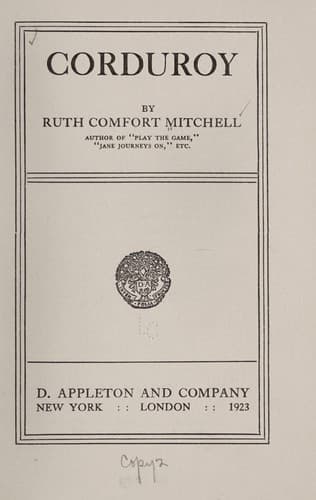
California -- Fiction; Ranch life -- Fiction; Young women -- Fiction
Ginger liked her cool compliments. She liked everything she did with
Mary Wiley. Perhaps, best of all, she liked the luncheons at the
Woman’s City Club and the Query Club and others to which her friend
belonged or went as a guest, where she--Ginger--might sit in mouselike
silence and hear brisk and vigorous talk. Mary Wiley sometimes spoke,
quietly and effectively. Once, in the midst of a discussion on the
iniquities of the retailer, she said suddenly--“I think Miss McVeagh
could tell us something of interest on that subject; you know, she
owns and operates one of the largest cattle ranches in her part of
California.”
“That _baby_?” A lean, elderly woman bent forward in her seat and
smiled at Ginger, and--her cheeks crisping hotly--she heard herself
speaking. It was incredible that they should all stop, those keen and
purposeful women--and listen to Ginger McVeagh, but they did.
“Did you get that, Helen?” she heard them saying to each other when
she had finished her three or four sentences. “That’s all she gets a
pound--and consider what we pay our local butchers!”
Several came and spoke to her afterward; California was always a name
to conjure with, they said, but a California cattle ranch-- They made
her feel definite and worth while; once Mary Wiley asked half a dozen
of them in to meet her at tea, and made her wear the red peasant dress.
But most of all she found herself at the Symphony. When she was
homesick, which was often, in spite of her new contentment, she found
that music--not solo things nor chamber music, but the crash and volume
of an orchestra--most nearly approximated the breadth and freedom of
her life at home. Sitting beside her friend or quite alone, serenely
ignorant of composition and composer and interdependence of instrument,
she was as wholly content as when she was riding Felipe or Diablo into
the heart of a sunset. When she tried, gropingly, to tell Mary Wiley
what she felt, she quoted to her a line of Huneker’s; it ought, she
thought, to be graven over the door of every concert hall: “Other arts
give us defined pleasures, but music is the only art that restores us
to ourselves.”
It restored Ginger not only to herself but to her lover. Whether they
ever came together again, whether she ever saw him again, sitting
perched in her high balcony seat in Carnegie Hall, all the pride and
criticism and bitterness were cleansed away; she went to him once more
as she had gone to him on Aleck’s bridge; she found harmony in harmony.
“You are radiant,” said Mary Wiley to her as they came away from
Carnegie on an afternoon of dazzling snow. “I knew you would love
Tschaikowsky. You look--my dear, did you love it so much?”
Ginger fell into step beside her. “Let’s walk, shall we? Yes; I loved
it. But I was thinking just then about--Mary, I would like to go to
Boston.”
“Would you, really? How warmly mother will approve of you for that
chaste desire!”
Public-domain text, read in full here on John Shaqi.
Reviews
Reviews
No reviews yet
Be the first to share your thoughts on this work.
Join the Discussion
Join the discussion
Sign in to leave a comment or review.
Sign InorCreate an account