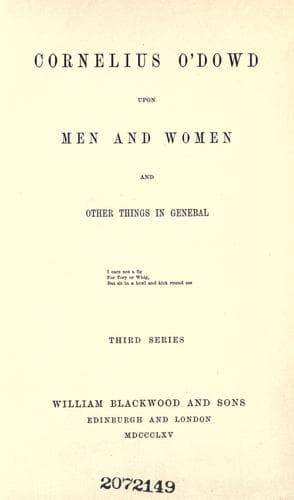
Cornelius O'Dowd Upon Men And Women And Other Things In GeneralLever, Charles
General
Cornelius O'Dowd Upon Men And Women And Other Things In General
Lever, Charles
Biography -- Humor; Essays; Italy -- Description and travel
A great many sea-captains discourage the use of life-preservers and
floating-belts on board ships of war, on the simple ground that men
should not be taught to rely for their safety on anything but what
conduces to save the ship. “Let there be but one thought, one effort,”
say they, “and let that be for the common safety.” If they be
right--and I suspect they are--we have made a famous blunder by our late
legislation about divorce. Of all the crafts that ever were launched,
marriage is one from which fewest facilities of desertion should be
provided.
Romanism makes very few mistakes in worldly matters. There is no feature
of that Church so remarkable as its deep study and thorough acquaintance
with all the moods and wants and wishes of humanity. Whatever its
demerits, one cannot but admit that no other religion ever approached
it in intimacy with the human heart in all its emotions and in all its
strivings, whether for good or evil.
Rome declares against all breach of the marriage tie. The Church, with
a spirit of concession it knows how to carry through all its dealings,
modifies, softens, assuages, but never severs conjugalism. It makes
the tie occasionally a slip-knot, but it never cuts the string, and I
strongly suspect that it is wise in its legislation.
For a great many years we gave the policy that amount of imitation we
are wont to accord to Romanist practices; that is, we follow them in
part--we adopt the coat, but, to show that we are not mere imitators,
we cut off one of the skirts; and if we do not make the garment more
graceful, we at least consult our dignity, and that is something. We
made divorce the privilege of men rich enough to come to Parliament for
relief; we did with the question what some one proposed we should do
with poisons--make them so costly that only wealthy men should be able
to afford the luxury of suicide. So long as men believed that divorce
was immoral, I don’t think any one complained that it should be limited
to persons in affluence. We are a lord-loving race, we English, and are
quite ready to concede that our superiors should have more vices than
ourselves, just as they have more horses and more pheasants; and we
deemed it nothing odd or strange that he, whose right it was to walk
into the House of Peers, should walk out of matrimony when it suited
him.
Public-domain text, read in full here on John Shaqi.
Reviews
Reviews
No reviews yet
Be the first to share your thoughts on this work.
Elsewhere in the archive
Join the Discussion
Join the discussion
Sign in to leave a comment or review.
Sign InorCreate an account