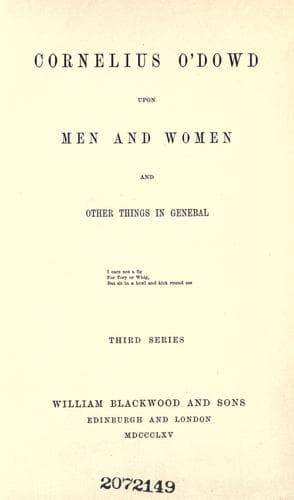
Cornelius O'Dowd Upon Men And Women And Other Things In GeneralLever, Charles
General
Cornelius O'Dowd Upon Men And Women And Other Things In General
Lever, Charles
Biography -- Humor; Essays; Italy -- Description and travel
Who knows?--perhaps we were flattered by the thought that great folk so
far conceded to a vulgar prejudice as to marry at all. Perhaps we hailed
their entrance into conjugalism as we are wont to do their appearance
at a circus or a public garden--a graceful acknowledgment that they
occasionally felt something like ourselves: at all events, we liked
it, and we showed we liked it by the zeal with which we read those
descriptions in newspapers of marriages in high life, and the delight
with which we talked to each other of people we never saw, nor probably
ever should see. It was not too much, therefore, to concede to them this
privilege of escape. It was very condescending of them to come to the
play at all; we had no right to insist that they should sit out the
whole performance.
By degrees, however, what with rich cotton-lords, and cheap
cyclopaedias, and penny trains, and popular lectures, there got up a
sort of impression--it was mere impression for a long time--that great
folk had more than their share of the puddings’ plums; and agitators
began to bestir themselves. What were the privileges of the higher
classes which would sit most gracefully on their inferiors? Naturally
we bethought us of their vices. It was not always so easy to adopt my
lord’s urbanity, his unassuming dignity, his well-bred ease; but one
might reasonably aspire to be as wicked. Sabbath-breaking had long since
ceased to be the privilege of the better classes, and so men’s minds
reverted to the question of divorce. “Let us get rid of our wives!”
cried they; “who knows but the day may come when we shall kill
woodcocks?”
Now the law, in making divorce a very costly process, had simply desired
to secure its infrequency. It was not really meant to be a rich man’s
privilege. What was sought for was to oppose as many obstacles as could
be found, to throw in as many rocks as possible into the channel, so
that only he who was intently bent on navigating the stream would ever
have the energy to clear the passage. Nobody ever dreamed of making it
an open roadstead. In point of fact, the oft-boasted equality before
the law is a myth. The penalty which a labourer could endure without
hardship might break my lord’s heart; and in the very case before us of
divorce, nothing can possibly be more variable than the estimate formed
of the divorced individuals, according to the class of society they move
in.
What would be a levity here, would be a serious immorality there; and
a little lower down again, a mere domestic arrangement, slightly more
decorous and a shade more legal than the old system of the halter and
the public sale. It was declared, however, that this “relief”--that is
the popular phrase in such matters--should be extended to the poor
man. It was decided that the privilege to get rid of a wife was, as
Mr Gladstone says of the electoral right, the inalienable claim of a
freeman, and the only course was to lower the franchise.
Public-domain text, read in full here on John Shaqi.
Reviews
Reviews
No reviews yet
Be the first to share your thoughts on this work.
Elsewhere in the archive
Join the Discussion
Join the discussion
Sign in to leave a comment or review.
Sign InorCreate an account