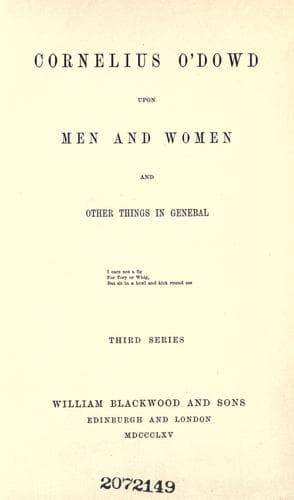
Cornelius O'Dowd Upon Men And Women And Other Things In GeneralLever, Charles
General
Cornelius O'Dowd Upon Men And Women And Other Things In General
Lever, Charles
Biography -- Humor; Essays; Italy -- Description and travel
A great authority in matters of evasion once protested that he would
engage to drive a coach-and-six through any Act of Parliament that ever
was framed, and I believe him. So certain is language to be too wide or
too narrow--to embrace too much, and consequently fail in
distinctness, or to include too little, and so defeat the attempt to
particularise--that it does not call for more than an ordinary amount of
acuteness to detect the flaws of such legislation. Then, when it comes
to a discussion, and amendments are moved, and some honourable gentleman
suggests that after the word “Whereas” in section 93 the clause should
run “in no case, save in those to be hereafter specified,” &c., there
comes a degree of confusion and obscurity that invariably renders
the original parent of the measure unable to know his offspring, and
probably intently determined to destroy it. That in their eagerness for
law-making the context of these bills is occasionally overlooked, one
may learn from the case of an Irish measure where a fine was awarded as
the punishment of a particular misdemeanour, and the Act declared that
one-half of the sum should go to the county, one-half to the informer.
Parliament, however, altered the law, but overlooked the context.
Imprisonment with hard labour was decreed as the penalty of the offence,
and the clause remained--“one-half to the county, one-half to the
informer.”
A Judge of no mean acuteness, the Chief Baron O’Grady, once declared,
with respect to an Act against sheep-stealing, that after two careful
readings he could not decide whether the penalties applied to the
owner, of the sheep, the thief, or the sheep itself, for that each
interpretation might be argumentatively sustained.
How will you suppress the organ-grinder after this? What are the limits
of a man’s domicile? How much of the coast does he own beyond his
area-railings? Is No. 48 to be deprived of the ‘Hat-catcher’s Daughter’
because 47 is dyspeptic? Are the maids in 32 not to be cheered by ‘Sich
a gettin’ up stairs’ because there is a nervous invalid in 33? How long
may an organ-man linger in front of a residence to tune or adjust his
barrels--the dreariest of all discords? Can legislation determine how
long or how loud the grand chorus in ‘Nabucco’ should be performed? What
endless litigation will be instituted by any attempt to provide for
all these and a score more of similar casualties, not to speak of the
insolent persecution that may be practised by the performance of tunes
of a party character. Fancy Dr Wiseman composing a pastoral to the air
of ‘Croppies, lie down,’ or the Danish Minister writing a despatch to
the inspiriting strains of ‘Schleswig-Holstein meer-umschlungen.’ There
might come a time, too, when ‘Sie sollen ihm nicht haben’ might grate on
a French ambassador’s ears. Can your Act take cognisance of all these?
Public-domain text, read in full here on John Shaqi.
Reviews
Reviews
No reviews yet
Be the first to share your thoughts on this work.
Join the Discussion
Join the discussion
Sign in to leave a comment or review.
Sign InorCreate an account