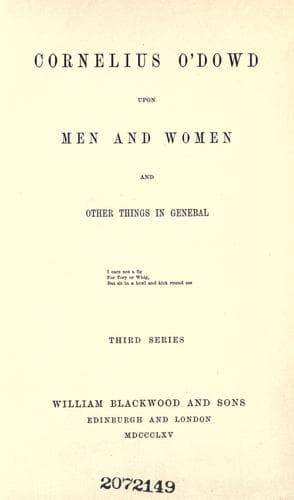
Cornelius O'Dowd Upon Men And Women And Other Things In GeneralLever, Charles
General
Cornelius O'Dowd Upon Men And Women And Other Things In General
Lever, Charles
Biography -- Humor; Essays; Italy -- Description and travel
The great, the fatal defect of all foreign Clubs is, the existence of
some one, perhaps two tyrants, who, by loud talk, swagger, an air of
presumed superiority and affectation of “knowing the whole thing,”
browbeat and ride rough-shod over all their fellows. It is in the want
of that wholesome corrective, public opinion, that this pestilence is
possible. Of public opinion the Continent knows next to nothing in any
shape; and yet it is by the unwritten judgments of such a tribunal that
society is guided in England, and the same law that discourages the
bully supports and encourages the timid, without either the one or the
other having the slightest power to corrupt the court, or coerce its
decrees. Club-life is, in a way, the normal school for parliamentary
demeanour; and until foreigners understand the Club, they will never
comprehend the etiquette of the “Chamber.”
A HINT FOR C. S. EXAMINERS.
I have frequently heard medical men declare that no test of a
candidate’s fitness to be admitted as a physician was equal to a brief
examination at the bedside of a sick man. To be able to say, “There is
a patient; tell us his malady, and what you will do for it,” was
infinitely better than long hours spent in exploring questions of minute
anatomy and theoretical physic. In fact, for all practical purposes,
it was more than likely he would be the best who would make the least
brilliant figure in an examination; and the man whose studies had
familiarised him with everything from Galen to John Hunter, would cut
just as sorry a figure if called on to treat a case of actual malady.
It cannot possibly be otherwise. All that mere examination can effect,
is to investigate whether an individual has duly prepared himself
for the discharge of certain functions; but it never can presume to
ascertain whether the person is one fitted by nature, by habit, by
taste, or inclination, for the duties before him. Why, the student who
may answer the most abstruse questions in anatomy, may himself have
nerves so weak as to faint at the sight of blood. The physician who has
Paracelsus by heart, may be so deficient in that tact of eye, or ear,
or touch, as to render his learning good for nothing. Half an hour in
an hospital would, however, test these qualities. You would at once see
whether the candidate was a mere mass of book-learning, or whether he
was one skilled in the aspect of disease, trained to observe and
note all the indications of malady, and able even instantaneously to
pronounce upon the gravity of a case before him. This is exactly what
you want. No examination of a man’s biceps and deltoid, the breadth of
his chest or the strength of his legs, would tell you whether he was
a good swimmer--five minutes in deep water would, however, decide the
matter.
Public-domain text, read in full here on John Shaqi.
Reviews
Reviews
No reviews yet
Be the first to share your thoughts on this work.
Elsewhere in the archive
Join the Discussion
Join the discussion
Sign in to leave a comment or review.
Sign InorCreate an account