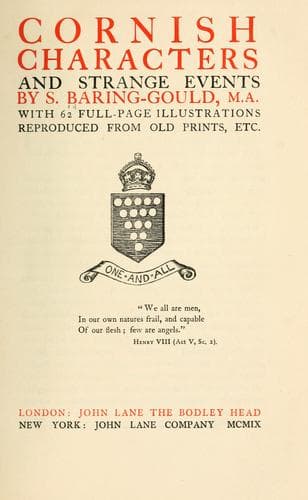
Cornish Characters and Strange EventsBaring-Gould, S. (Sabine)
History
Cornish Characters and Strange Events
Baring-Gould, S. (Sabine)
Cornwall (England : County) -- Biography; Cornwall (England : County) -- History; Legends -- England -- Cornwall (County)
During 1645 and 1646 he carried on a correspondence with Edward Hyde,
afterwards Earl of Clarendon, on the condition of the Royalist cause in
Cornwall. Liskeard had fallen into the hands of the Parliamentarians,
but Sir Ralph Hopton defeated Ruthven on Braddock Down on January 19th,
1643, and recovered Liskeard for the King. Ruthven fled to Saltash,
which he fortified with much expedition.
When the Royal cause was lost the vengeance of the Parliament fell on
Joseph Jane, and he was nearly ruined by the heavy composition he was
forced to pay. In 1650, and again in 1654, he was named Clerk of the
Royal Council, but it was an empty honour; Charles II could pay
nothing, and the Council could only grumble and plot.
Jane attempted to answer Milton's Εικονοκλαστης in a work, Εικων
ακλαστος the Unbroken Image, but it was a poor performance. It was
published in 1651; Hyde says, however, in a letter to Secretary
Nicholas, "the King hath a singular good esteem both of Joseph Jane
and of his book."
He had a son, William Jane, baptized at Liskeard, 22nd October, 1645,
who was educated at Westminster School, elected student of Christ
Church, Oxford, 1660, and graduated B.A. in 1664, and M.A. in 1667,
and D.D. in 1674. After his ordination he was appointed lecturer at
Carfax. He attracted the attention of Henry Compton, who became Canon
of Christ Church in 1669, by his sturdy loyalty and orthodoxy; and
when Compton became Bishop of Oxford, he chose Jane to preach the
sermon at his consecration, and he appointed him one of his chaplains.
In 1670 he became Canon of Christ Church, and was given the living of
Winnington in Essex. In 1679 he received a prebendal stall in S. Paul's
Cathedral and the archdeaconry of Middlesex. In May, 1680, he was
appointed Regius Professor of Divinity at Oxford. This rapid promotion
was due in part to the staunch loyalty of his father and the losses of
his family on that account, but also to his cool, businesslike
abilities, and to his learning, which though not profound was good.
In July, 1683, he framed the Oxford declaration in favour of Passive
Obedience, and committed the University to an opinion which subsequent
events were calculated to stultify.
Public-domain text, read in full here on John Shaqi.
Reviews
Reviews
No reviews yet
Be the first to share your thoughts on this work.
Elsewhere in the archive
Join the Discussion
Join the discussion
Sign in to leave a comment or review.
Sign InorCreate an account