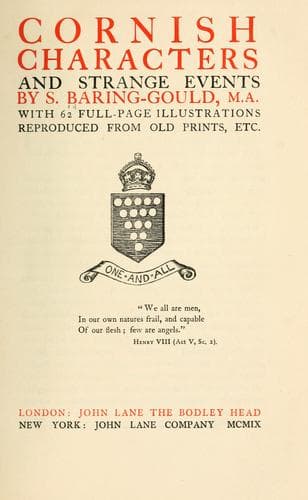
Cornish Characters and Strange EventsBaring-Gould, S. (Sabine)
History
Cornish Characters and Strange Events
Baring-Gould, S. (Sabine)
Cornwall (England : County) -- Biography; Cornwall (England : County) -- History; Legends -- England -- Cornwall (County)
Then followed clauses providing that a clergyman might wear the
surplice or not as he thought fit; it left the sign of the cross
optional in baptism; and provided that the Eucharist need not be
received kneeling. The concluding clause was drawn in the form of a
petition; it was proposed that the two Houses should request the King
and the Queen to issue a commission empowering thirty divines of the
Church of England to revise the liturgy, the canons, and the
constitution of the ecclesiastical courts, and to recommend such
alterations as might seem to them desirable.
But this Bill roused serious opposition. It was felt by all who had any
respect and feeling for the Church, as one in all times from the
Apostolic period, who regarded her claim to maintain the same faith, the
same Apostolic constitution and the same sacraments, as from the
earliest age of the Church, that this Comprehension Bill if it became
law must of necessity alienate them from such a body--drenched with
Protestantism, till scarcely a tinge of the old wine of Catholicism
remained in her; and would leave them no other course open than to shake
off the dust of their feet against her and join the Church of Rome, or
the Church of the Nonjurors. Most of the bishops who had taken the oaths
to William and Mary were placed on the Commission; and with them were
joined twenty priests of note. Of these twenty, Tillotson was the most
important as expressing the mind and wishes of the King. He was a
latitudinarian, without a spark of feeling for historic Christianity.
With him went Stillingfleet, Dean of S. Paul's, Sharp, Dean of Norwich,
Patrick, Dean of Peterborough, Tenison, Rector of S. Martin's, and
Fowler. But conspicuous on the other side were Aldrich, Dean of Christ
Church, and Jane, Regius Professor of Divinity at Oxford.
Early in October, 1689, the commissioners assembled in the Jerusalem
Chamber. But hardly had they met before Sprat, Bishop of Rochester,
started up and denied that the Commission was legal. There was a sharp
altercation, violent words were flung about, and Sprat, Jane, and
Aldrich withdrew. The strength of the Catholic party was broken, and
the rest agreed to sanction nearly all the changes advocated by those
who desired to entirely alter the character of the Church.
Public-domain text, read in full here on John Shaqi.
Reviews
Reviews
No reviews yet
Be the first to share your thoughts on this work.
Elsewhere in the archive
Join the Discussion
Join the discussion
Sign in to leave a comment or review.
Sign InorCreate an account