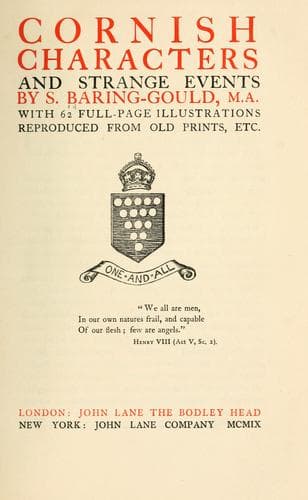
Cornish Characters and Strange EventsBaring-Gould, S. (Sabine)
History
Cornish Characters and Strange Events
Baring-Gould, S. (Sabine)
Cornwall (England : County) -- Biography; Cornwall (England : County) -- History; Legends -- England -- Cornwall (County)
"They had before them," Burnet tells us, "all the exceptions that
either the Puritans before the war, or the Nonconformists since the
Restoration, had made to any part of the Church service; they had also
many propositions and advices that had been offered, at several times,
by many of our bishops and divines upon those heads; matters were well
considered and freely and calmly debated; and all digested into an
entire correction of everything that seemed liable to any just
objection." To guide them, as Burnet admits in his Triennial
Visitation Charge of 1704, they were furnished with a great collection
of the books and papers in which the Dissenters had at different times
set forth their demands. The Commission was prepared to surrender
everything. The chanting of psalms, even in cathedrals, was to be done
away with. The lessons from the Apocrypha were to be abolished. The
Saints' days omitted from the Calendar, the form of absolution
altered, remission of sins to be removed from it "as not very
intelligible." The cross in baptism, the use of god-parents, the
wearing of the surplice were to be optional. Episcopal ordination was
not to be required of the Ministry. Kneeling to receive the Holy
Communion was left to the choice of the Communicant; the collects, as
too concise, were to be blown out with pious bombast.
It is possible that, as Calamy asserts, such alterations as these
would have brought over two-thirds of the English Dissenters to the
Established Church; but it is certain that it would have driven
two-thirds of the members of the Church, lay and clerical, out of her,
as having forfeited her claim to be a branch of the Catholic Church,
and they would probably have swelled the ranks of the Nonjurors, and
made of that communion a body that would have really represented the
Church in England.
Owing to the secession of the Nonjurors, sees and benefices had been
filled with men who were in sympathy with the views of Tillotson and
Burnet, or who were only solicitous to live in the smiles of William.
Little resistance, if any, was to be expected from the episcopal bench.
When the Commission had concluded its labours, writs were issued
summoning the Convocation of the Province of Canterbury. The clergy
were in a ferment throughout England. They thought that the heritage
of faith was going to be taken from them. The Toleration Act had
removed the disabilities of the Dissenters; they might build their
conventicles and preach what and when they liked; why, then, open the
doors of the Church to admit them as a flood to swamp the faithful?
When the Declaration of Toleration had been issued by James II, in
1687, removing all disabilities from the Dissenters, on the sole
understanding that they should abstain from attacking the Churches of
Rome and England, their preachers found that they had nothing to say.
They preferred to be under disabilities rather than give up assaults
on the Scarlet Woman, Babylon, the Beast, and Prelacy, its shadow.
Public-domain text, read in full here on John Shaqi.
Reviews
Reviews
No reviews yet
Be the first to share your thoughts on this work.
Elsewhere in the archive
Join the Discussion
Join the discussion
Sign in to leave a comment or review.
Sign InorCreate an account