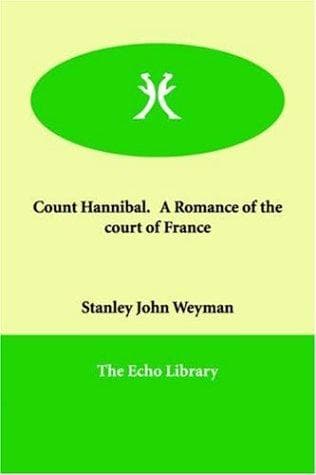
Count Hannibal: A Romance of the Court of FranceWeyman, Stanley John
General
Count Hannibal: A Romance of the Court of France
Weyman, Stanley John
Courts and courtiers -- Fiction; Huguenots -- Fiction
The movements of the women had overturned two of the candles; a third had
guttered out. The three which still burned, contending pallidly with the
daylight that each moment grew stronger, imparted to the scene the air of
a debauch too long sustained. The disordered board, the wan faces of the
servants cowering in their corner, Mademoiselle's frozen look of misery,
all increased the likeness; which a common exhaustion so far strengthened
that when Tavannes turned from the window, and, flushed with his triumph,
met the others' eyes, his seemed the only vigour, and he the only man in
the company. True, beneath the exhaustion, beneath the collapse of his
victims, there burned passions, hatreds, repulsions, as fierce as the
hidden fires of the volcano; but for the time they smouldered ash-choked
and inert.
He flung the discharged pistols on the table. "If yonder raven speak
truth," he said, "I am like to pay dearly for my wife, and have short
time to call her wife. The more need, Mademoiselle, for speed,
therefore. You know the old saying, 'Short signing, long seisin'? Shall
it be my priest, or your minister?"
M. de Tignonville started forward. "She promised nothing!" he cried. And
he struck his hand on the table.
Count Hannibal smiled, his lip curling. "That," he replied, "is for
Mademoiselle to say."
"But if she says it? If she says it, Monsieur? What then?"
Tavannes drew forth a comfit-box, such as it was the fashion of the day
to carry, as men of a later time carried a snuff-box. He slowly chose a
prune.
"If she says it?" he answered. "Then M. de Tignonville has regained his
sweetheart. And M. de Tavannes has lost his bride."
"You say so?"
"Yes. But--"
"But what?"
"But she will not say it," Tavannes replied coolly.
"Why not?"
"Why not?"
"Yes, Monsieur, why not?" the younger man repeated, trembling.
"Because, M. de Tignonville, it is not true."
"But she did not speak!" Tignonville retorted, with passion--the futile
passion of the bird which beats its wings against a cage. "She did not
speak. She could not promise, therefore."
Tavannes ate the prune slowly, seemed to give a little thought to its
flavour, approved it a true Agen plum, and at last spoke.
"It is not for you to say whether she promised," he returned dryly, "nor
for me. It is for Mademoiselle."
"You leave it to her?"
"I leave it to her to say whether she promised."
Public-domain text, read in full here on John Shaqi.
Reviews
Reviews
No reviews yet
Be the first to share your thoughts on this work.
Join the Discussion
Join the discussion
Sign in to leave a comment or review.
Sign InorCreate an account