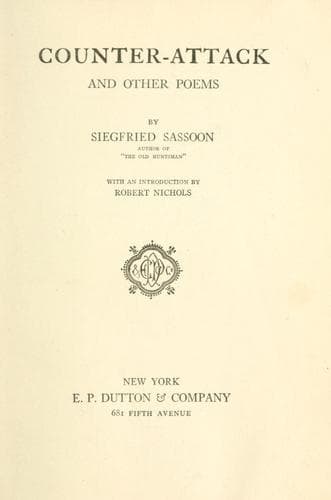
This book (in consequence almost wholly of these
bitter poems) enjoyed a remarkable success with the
soldiers fighting in France. One met it everywhere.
"Hello, you know Siegfried Sassoon then, do you?
Well, tell him from me that the more he lays it on thick
to those who don't realize the war the better. That's
the stuff we want. We're fed up with the old men's
death-or-glory stunt." In 1918 appeared 'Countermans'
Attack': here there is hardly a trace of the 'paradise'
feeling. You can't even think of paradise when you're
in hell. For Sassoon was now well along the way of
thorns. How many lives had he not seen spilled apparently
to no purpose? Did not the fact of war arch
him in like a dirty blood-red sky? He breaks out,
almost like a mad man, into imprecations, into
vehement tirades, into sarcasms, ironies, the hellish
laughters that arise from a heart that is not broken
once for all but that is newly broken every day while
the Monster that devours the lives of the young
continues its ravages. Take, for instance, the magnificent
'To Any Dead Officer', written just before America
entered the war. Many reading this poem would think
Great Britain was going to cease fighting. But nothing
of the sort. One must always remember that bitter
as these imprecations are against those who mismanaged
certain episodes in the war, the ultimate foe
is not they but the German Junkers who planned this
war for forty years, who have given the lovely earth
over to hideous defilement and the youths of all nations
to carnage...
Sometimes in this book Sassoon fails to express himself
properly. This fact is, I think, a tribute to his
sincerity. For his earlier work very clearly displays
his technical proficiency. But here what can he do?
Indignation chokes and strangles him. He claws often
enough at unsatisfactory words, dislocates his
sentences, tumbles out his images as if he would pulp the
makers of war beneath them. Very rarely does he
attain to the poignant simplicity of 'The Hawthorn
Tree' or the detached irony of 'Does it Matter?'
Can he then see nothing else in war? I remember
him once turning to me and saying suddenly apropos
of certain exalté poems in my 'Ardours and
Endurances': 'Yes, I see all that and I agree with
you, Robert. War has made me. I think I am a man now
as well as a poet. You have said the things well
enough. Now let us nevermore say another word of
whatever little may be good in war for the individual
who has a heart to be steeled.'
I remember I nodded, for further acquaintance with
war inclines me to his opinion.
'Let no one ever,' he continued, 'from henceforth
say a word in any way countenancing war. It is dangerous
even to speak of how here and there the individual
may gain some hardship of soul by it. For war
is hell and those who institute it are criminals. Were
there anything to say for it, it should not be said for
its spiritual disasters far outweigh any of its advantages.'
Public-domain text, read in full here on John Shaqi.
Reviews
Reviews
No reviews yet
Be the first to share your thoughts on this work.
Join the Discussion
Join the discussion
Sign in to leave a comment or review.
Sign InorCreate an account