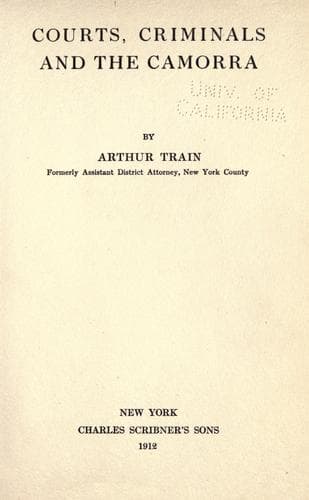
Courts, Criminals and the CamorraTrain, Arthur Cheney
History
Courts, Criminals and the Camorra
Train, Arthur Cheney
Camorra; Criminals -- United States; Justice, Administration of -- United States
Then, to the false and exaggerated cable of the correspondent the
“write-up man” lends his imagination; significant and important facts
are omitted altogether, and the public is led to believe that an
Italian criminal trial consists of a yelling bandit in a straitjacket,
with a hysterical judge and frenzied lawyer abusing each other’s
character and ancestry.
Let the writer state, at the outset, that he has never in his legal
experience seen a judge presiding with greater courtesy, patience,
fairness, or ability, or keeping, as a general rule, under all the
circumstances, so perfect a control over his court, as the president of
the assize in which the prosecution of the Camorra is being conducted;
nor is he familiar with any legal procedure better fitted to ascertain
the truth of the charges being tried.
In studying the Camorra trial at Viterbo, or any other Italian or
French criminal proceeding, the reader must bear in mind that there
is a fundamental distinction between them and our own, and that
there are two great and theoretically entirely different systems of
criminal procedure, one of which is the offspring of the Imperial
Roman law and the other entirely Anglo-Saxon. One is the Roman or
inquisitorial system, and the other the English or controversial.
Under the former the officers of the state are charged with the duty
of ferreting out and punishing crime wherever found, and the means
placed at their disposal are those likely to be most effective for the
purpose. The theory of the latter is that, to some extent at least,
a criminal trial is the result of a dispute between two persons, one
the accuser and the other the accused, and that the proceeding savors
of a private law-suit. Now, it is obvious that, in principle at
least, the two systems differ materially. In the one, the only thing
originally considered was the best way to find out whether a criminal
were guilty and to lock him up, irrespective of whether or not any
private individual had brought an accusation against him. In the other,
somebody had to make a complaint and “get his law” by going after it
himself to a very considerable extent.
Public-domain text, read in full here on John Shaqi.
Reviews
Reviews
No reviews yet
Be the first to share your thoughts on this work.
Elsewhere in the archive
Join the Discussion
Join the discussion
Sign in to leave a comment or review.
Sign InorCreate an account