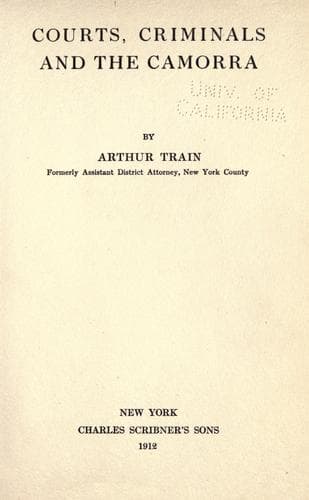
Courts, Criminals and the CamorraTrain, Arthur Cheney
History
Courts, Criminals and the Camorra
Train, Arthur Cheney
Camorra; Criminals -- United States; Justice, Administration of -- United States
The history of the development of these diverse theories of criminal
procedure is too involved to be discussed here at any length, but
inasmuch as the most natural way of ascertaining whether or not
a person has been guilty of a crime is to question him about it,
the leading feature of the Continental system is the “question,”
or inquisitorial nature of the proceedings, whereby the police
authorities, who are burdened with the discovery and prosecution of
crime, initiate the whole matter and bring the defendant and their
witnesses before an examining magistrate in the first instance. The
_procureur_ (district attorney) in France and the _procuratore del re_
in Italy represent the government and _are part of the magistracy_.
They are actually quasi-judicial in their character, and their powers
are infinitely greater than those of our own prosecutors, who occupy a
rather anomalous position, akin in some ways to that of a _procureur_,
and at the same time, under our controversial practice, acting as
partisan attorneys for the people or the complainant.
The fundamental proposition under the inquisitorial system is that
the proceeding is _the government’s business_, to be conducted by
its officers by means of such investigations and interrogations as
will most likely get at the truth. Obviously, the quickest and surest
means of determining the guilt of a defendant is to put him through
an exhaustive examination as soon as possible after the crime, under
such surroundings that, while his rights will be safeguarded, the
information at his disposal will be elicited for the benefit of the
public. The fact that in the past the Spanish Inquisition made use of
the rack and wheel, or that to-day the “third degree” is freely availed
of by the American police, argues nothing against the desirability
of a public oral examination of a defendant in a criminal case. If
he be given, under our law, the _right_ to testify, why should he be
_privileged_ to remain silent?
The Anglo-Saxon procedure, growing up at a time when death was the
punishment for almost every sort of offence, and when torture was
freely used to extort confessions of guilt, developed an extraordinary
tenderness for accused persons, which has to-day been so refined and
extended by legislation in America that there is a strong feeling among
lawyers (including President Taft) that there is much in our practice
which has outlived its usefulness, and that some elements of Latin
procedure, including the compulsory interrogation of defendants in
criminal cases, have a good deal to recommend them.
Public-domain text, read in full here on John Shaqi.
Reviews
Reviews
No reviews yet
Be the first to share your thoughts on this work.
Elsewhere in the archive
Join the Discussion
Join the discussion
Sign in to leave a comment or review.
Sign InorCreate an account