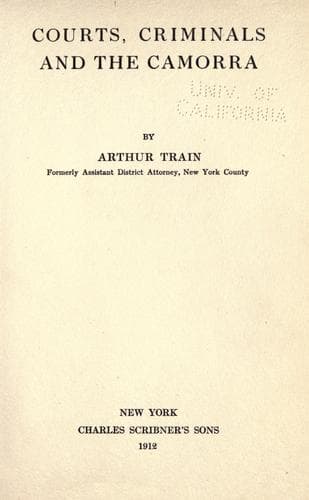
Courts, Criminals and the CamorraTrain, Arthur Cheney
History
Courts, Criminals and the Camorra
Train, Arthur Cheney
Camorra; Criminals -- United States; Justice, Administration of -- United States
The president having taken his place, the first order of the day is
the reading or revision of all or part of the record of the preceding
session. This is done by the _cancelliere_ who, from time to time,
is interrupted by the lawyers, Abbatemaggio, or the prisoners. These
interruptions are usually to the point, and are quickly disposed
of by the judge, although he may allow an argument thereon at some
length from one of the advocates. The court then proceeds with the
introduction of evidence, documentary or otherwise, the examination of
the witnesses, or the confronting of the prisoners with their accusers.
Now is immediately observable for the first time the characteristic
of Italian criminal procedure which has been so much misrepresented
and has been the cause of such adverse criticism in the United States
and England—namely, the constant interruption of the proceedings by
argument or comment from the lawyers, and by remarks and contradictions
from the prisoners and witnesses. These occasionally degenerate into
altercations of a more or less personal nature; but they are generally
stilled at a single word of caution from the judge, and serve to bring
out and accentuate the different points at issue and to make clear the
position of the different parties. When such interruptions occur, the
proceedings ordinarily resemble a joint discussion going on among a
fairly large gathering of people presided over by a skilful moderator.
A witness is testifying. In the middle of it (and “it” consists of not
only what the witness has seen, but what he has been told and believes)
one of the prisoners rises and cries out:
“That is not so! He is a liar! Abbatemaggio swore thus and so.”
“Nothing of the kind!” retorts the witness impatiently.
“Yes! Yes!” or “No! No!” chime in the advocates.
“Excellency! Excellency!” exclaims Abbatemaggio himself, jumping to his
feet in his cage. “I said in my testimony that Cuocolo _did_ accuse
Erricone,” etc. And he goes on for two or three minutes, explaining
just what he did or did not say or mean, while the president listens
until he has had sufficient enlightenment, and stops him with a sharp
“_Basta!_” (“Enough!”).
Public-domain text, read in full here on John Shaqi.
Reviews
Reviews
No reviews yet
Be the first to share your thoughts on this work.
Elsewhere in the archive
Join the Discussion
Join the discussion
Sign in to leave a comment or review.
Sign InorCreate an account