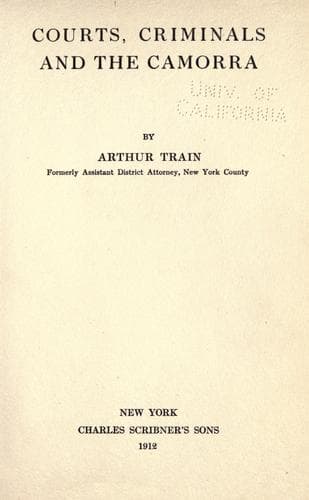
Courts, Criminals and the CamorraTrain, Arthur Cheney
History
Courts, Criminals and the Camorra
Train, Arthur Cheney
Camorra; Criminals -- United States; Justice, Administration of -- United States
The incident (whatever its nature) usually tends to elucidate the
matter, and while to an outsider, especially one not familiar with
Italian dialects, the effect may be one of temporary confusion, it is
nevertheless not as disorderly as it seems, and the president rarely
(so far as the writer could see during many days of observation) loses
complete command of his court, or permits any one to go on talking
unless for a clear and useful purpose. At times, when everybody
seemed to be talking at once, and several lawyers, Abbatemaggio, and
one or two prisoners were on their feet together, his handling of
the situation was little short of marvellous, for he would almost
simultaneously silence one with a sharp “S-s-s!” shake his head at
another, direct a third to sit down, and listen to a fourth until
he stilled him with a well-directed “_Basta_!” When the shouting is
over, one usually finds that who is the liar has been pretty clearly
demonstrated.
In this connection, however, it should be said that the writer was
perhaps fortunate (or unfortunate, as the reader may prefer) in not
being present on those days when the scenes of greatest excitement
and confusion occurred. Several times, it is true, President Bianchi
has preferred to adjourn court entirely on account of the uproar,
rather than take extreme measures against individual defendants or
witnesses. Thus, during the entire conduct of the case and in spite
of the grossest provocation, he has ordered the forcible removal of
only three defendants—that of Morro on June 21, 1911, and of Alfano
and Abbatemaggio on July 21, 1911. On several other occasions he
has adopted the more gentle expedient of adjourning the proceedings
and clearing the court, and this has resulted in a certain amount of
criticism from the Italian bar, which otherwise regards his presiding
as a model of efficiency. The only adverse comment that the writer has
heard in Italy, either of the president or the _procuratore del re_, is
that both are somewhat lenient toward the conduct of the prisoners and
their advocates, and lack strength in dealing with exigencies of the
character just described. In the long run, however, if such criticism
be just, such an attitude is bound to be in favor of justice, and will
irresistibly convince the public and the world at large that this is no
attempt on the part of the government to “railroad” a lot of suspected
undesirables at any cost, whatever the evidence may be.
Public-domain text, read in full here on John Shaqi.
Reviews
Reviews
No reviews yet
Be the first to share your thoughts on this work.
Elsewhere in the archive
Join the Discussion
Join the discussion
Sign in to leave a comment or review.
Sign InorCreate an account