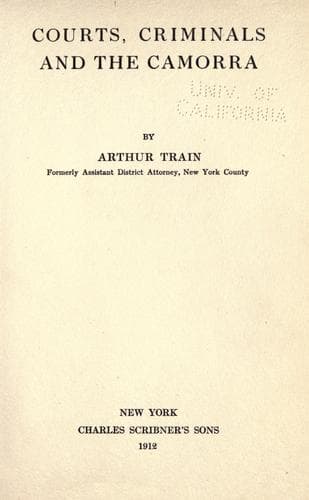
Courts, Criminals and the CamorraTrain, Arthur Cheney
History
Courts, Criminals and the Camorra
Train, Arthur Cheney
Camorra; Criminals -- United States; Justice, Administration of -- United States
appeal in case of an acquittal) proceeds to mix things up generally
by an unfair and confusing cross-examination. At last the defendant
is called, and marches to the stand, looking like an early Christian
martyr. He is carefully interrogated by his lawyer, who permits him (if
he be wise) to do nothing but deny the salient facts against him. The
district attorney, to be sure, has the right of cross-examination, but
a skilful criminal lawyer has plenty of opportunities to “nurse” his
client along and guide him over pitfalls; and when all is over the jury
have formed no valuable or accurate impression of the defendant’s real
character and personality—whether or not, in other words, he is the
kind of man who _would have done_ such a thing.
In Italy (to use vulgar English) they “sic” them at each other and
let them fight it out, and while the language of the participants is
often not parliamentary, the knowledge that they are being watched
by the judge and jury has a restraining effect, and the presence of
the carabinieri makes violence no more likely than in our own courts.
Occasionally, in America, where a prisoner insists on conducting his
own defence, a similar scene may be witnessed—always, it may be
affirmed, to the enlightenment of the jury. On the other hand, most
confrontations are attended with few sensational incidents or emotional
outbreaks.
The writer was fortunate enough to be present when “Professor”
Rapi was confronted by Gennaro Abbatemaggio, and, to his surprise,
found that the proceeding, instead of being interspersed with yells
of rage and vehement invocations to Heaven, closely resembled a
somewhat personal argument between two highly intelligent and deeply
interested men of affairs. Whatever may be Rapi’s real character (and
he is said to supply a large part of the brains of the Camorra, as
well as handling all its funds), he is, as he stands up in court, a
fine-looking, elegantly dressed man, of polished manners and speech.
If the evidence against him is to be believed, however, his mask of
gentility covers a heart of mediæval cruelty and cunning, for he is
alleged to have made the plans and given the final directions to
Sortino for the murder of the Cuocolos. Rapi is a celebrated gambler,
and as such may have had the acquaintance of some decadent members of
the Italian aristocracy, who not only knew him in the betting ring at
the races, but frequented his establishment in Naples, which he called
the “Southern Italy Club.” In 1875, at the age of eighteen, he won
against four hundred candidates the position of instructor in classical
languages in the municipality of Naples. Some ten years later, in 1884,
he moved with his parents to France. At this time he was suspected of
having something to do with the murder of a Camorrist youth, named
Giacomo Pasquino, who, in fact, was killed in a duel with a fellow
member of the society.
Public-domain text, read in full here on John Shaqi.
Reviews
Reviews
No reviews yet
Be the first to share your thoughts on this work.
Elsewhere in the archive
Join the Discussion
Join the discussion
Sign in to leave a comment or review.
Sign InorCreate an account