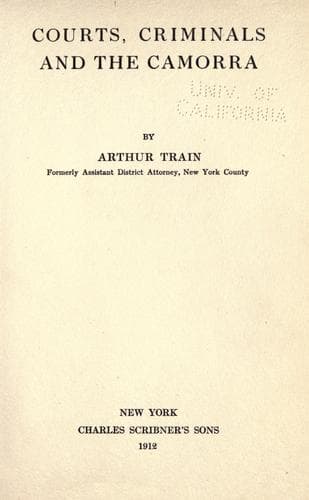
Courts, Criminals and the CamorraTrain, Arthur Cheney
History
Courts, Criminals and the Camorra
Train, Arthur Cheney
Camorra; Criminals -- United States; Justice, Administration of -- United States
It must not be supposed that the trial of the Camorra is being
conducted with the calm of a New England Sabbath service; but the
writer wishes to emphasize the fact that the confusion, such as it
is, serves a certain purpose, and that the yellings and heartrending
outcries described by the newspaper correspondents are only occasional
and much exaggerated—except in so far as they might occur at an
Italian trial in America. Any one who has been present at many murder
trials in New York knows that outbreaks on the part of Italian
prisoners are to be anticipated and are frequent if not customary.
The writer recalls more than one case where the defendant shrieked
and rolled on the floor, clutching at the legs of tables, chairs, and
officers, until dragged by main force from the court-room. And at
Viterbo they are trying thirty-six Italians at the same time; and every
person participating in or connected with the affair is an Italian,
sharing in the excitability and emotional temperament of his fellows.
A noteworthy feature of this particular prosecution is that (due
doubtless to the strength and ability of the presiding judge), in
spite of all interruptions and the freedom of discussion, the taking
of evidence proceeds with a rapidity greater than in America, for
the reason that there are no objections or exceptions, or attendant
argument, and, above all, no cross-examination, except such questions
as are put by the judge himself at the request of the advocates.
Finally, the system of the _confronto_, or confronting of the accused
by his accuser, deserves a word of commendation, for no method could
possibly be devised whereby the real character and comparative
truthfulness of each would be so readily disclosed. The defendant is
given on this occasion free scope to cross-examine the witness and
deny or refute what he says, and it takes ordinarily but a few minutes
before the mask is torn aside and each pictures himself in his true
colors. Our procedure tends to deprive the witnesses of personality
and to reduce them all to a row of preternaturally solemn and formal
puppets. It is probably true that in most criminal cases in America
the defendant is convicted or acquitted without the jury having any
very clear idea of what sort of person he really is. On the day of
his trial the prisoner makes a careful toilet, is cleanly shaved, and
dons a new suit of clothes and fresh linen. The chances are that, as
he sits at the bar of justice, he will make at least as good and very
possibly a more favorable impression upon the jury than the witnesses
against him, who have far less at stake than he. Each takes the stand
and is sworn to tell the truth, so far as they will be permitted to do
so under our rules of evidence. Then the district attorney proceeds to
try to extract their story of the crime under a storm of objections,
exceptions, and hasty rulings from the judge. Then the prisoner’s
lawyer (who can take all the liberties he wants, as the State has no
Public-domain text, read in full here on John Shaqi.
Reviews
Reviews
No reviews yet
Be the first to share your thoughts on this work.
Elsewhere in the archive
Join the Discussion
Join the discussion
Sign in to leave a comment or review.
Sign InorCreate an account