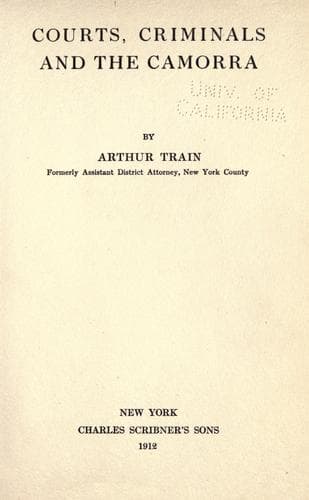
Courts, Criminals and the CamorraTrain, Arthur Cheney
History
Courts, Criminals and the Camorra
Train, Arthur Cheney
Camorra; Criminals -- United States; Justice, Administration of -- United States
According to this code, a man who appeals to the law against
his fellow man is not only a fool but a coward, and he who
cannot take care of himself without the protection of the
police is both.... It is reckoned as cowardly to betray an
offender to justice, even though the offence be against one’s
self, as it would be not to avenge an injury by violence. It
is regarded as dastardly and contemptible in a wounded man
to betray the name of his assailant, because if he recovers
he must naturally expect to take vengeance himself. A rhymed
Sicilian proverb sums up this principle, the supposed speaker
being one who has been stabbed. “If I live, I will kill
thee,” it says; “if I die, I forgive thee!”
Any one who has had anything to do with the administration of criminal
justice in a city with a large Italian population must have found
himself constantly hampered by precisely this same “Omertà.” The south
Italian feels obliged to conceal the name of the assassin and very
likely his person, though he himself be but an accidental witness of
the crime; and, while the writer knows of no instance in New York City
where an innocent man has gone to prison himself rather than betray a
criminal, Signor Cutera, formerly chief of police in Palermo, states
that there have been many cases in Sicily where men have suffered long
terms of penal servitude and even have died in prison rather than give
information to the police.
In point of fact, however, the “Omertà” is not confined to Italians.
It is a common attribute of all who are opposed to authority of any
kind, including small boys and criminals, and with the latter arises no
more from a half chivalrous loyalty to their fellows than it does from
hatred of the police and a uniform desire to block their efforts (even
if a personal adversary should go unpunished in consequence), fear that
complaint made or assistance given to the authorities will result in
vengeance being taken upon the complainant by some comrade or relative
of the accused, distrust of the ability of the police to do anything
anyway, disgust at the delay involved, and lastly, if not chiefly, the
realization that as a witness in a court of justice the informer as a
professional criminal would have little or no standing or credence, and
in addition would, under cross-examination, be compelled to lay bare
the secrets of his unsavory past, perhaps resulting indirectly in a
term in prison for himself.[18] Thus may be accounted for much of the
supposed “romantic, if misguided, chivalry” of the south Italian. It is
common both to him and to the Bowery tough. The writer knew personally
a professional crook who was twice almost shot to pieces in Chatham
Square, New York City, and who persistently declined, even on his dying
bed, to give a hint of the identity of his assassins, announcing that
if he got well he “would attend to that little matter himself.” Much
of the romance surrounding crime and criminals, on examination, “fades
Public-domain text, read in full here on John Shaqi.
Reviews
Reviews
No reviews yet
Be the first to share your thoughts on this work.
Elsewhere in the archive
Join the Discussion
Join the discussion
Sign in to leave a comment or review.
Sign InorCreate an account