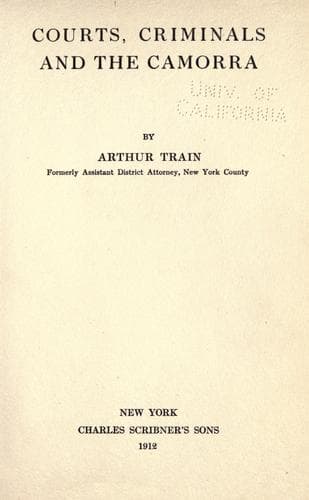
Courts, Criminals and the CamorraTrain, Arthur Cheney
History
Courts, Criminals and the Camorra
Train, Arthur Cheney
Camorra; Criminals -- United States; Justice, Administration of -- United States
into the light of common day”—the obvious product not of idealism, but
of well-calculated self-interest.
As illustrating the backwardness of our Italian fellow-citizens in
coming forward when the criminality of one of their countrymen is at
stake, the last three cases of kidnapping in New York City may be
mentioned.
About a year and a half ago the little boy of Dr. Scimeca, of 2 Prince
Street, New York, was taken from his home. From outside sources the
police heard that the child had been stolen, but, although he was
receiving constant letters and telephonic communications from the
kidnappers, Dr. Scimeca would not give them any information. It is
known on pretty good authority that the sum of $10,000 was at first
demanded as a ransom, and was lowered by degrees to $5,000, $2,500, and
finally to $1,700. Dr. Scimeca at last made terms with the kidnappers,
and was told to go one evening to City Park, where he is said to have
handed $1,700 to a stranger. The child was found wandering aimlessly in
the streets next day, after a detention of nearly three months.
The second case was that of Vincenzo Sabello, a grocer of 386 Broome
Street, who lost his little boy on August 26, 1911. After thirty days
he reported the matter to the police, but shortly after tried to throw
them off the track by saying that he had been mistaken, that the boy
had not been kidnapped, and that he wished no assistance. Finally he
ordered the detectives out of his place. About a month later the child
was recovered, but not, according to reliable information, until Mr.
Sabello had handed over $2,500.
Pending the recovery of the Sabello boy, a third child was stolen from
the top floor of a house at 119 Elizabeth Street. The father, Leonardo
Quartiano, reported the disappearance, and in answer to questions
stated that he had received no letters or telephone messages. “Why
should I?” he inquired, with uplifted hands and the most guileless
demeanor. “I am poor! I am a humble fishmonger.” In point of fact,
Quartiano at the time had a pocketful of blackmail letters, and after
four weeks paid a good ransom and got back his boy.
It is impossible to estimate correctly the number of Italian
_criminals_ in America or their influence upon our police statistics;
but in several classes of crime the Italians furnish from fifteen to
fifty per cent of those convicted. In murder, assault with intent
to kill, blackmail, and extortion they head the list, as well as in
certain other offences unnecessary to describe more fully but prevalent
in Naples and the South.
Public-domain text, read in full here on John Shaqi.
Reviews
Reviews
No reviews yet
Be the first to share your thoughts on this work.
Elsewhere in the archive
Join the Discussion
Join the discussion
Sign in to leave a comment or review.
Sign InorCreate an account