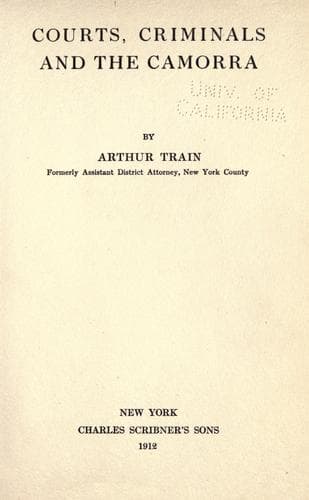
Courts, Criminals and the CamorraTrain, Arthur Cheney
History
Courts, Criminals and the Camorra
Train, Arthur Cheney
Camorra; Criminals -- United States; Justice, Administration of -- United States
So the other, with beads of sweat on his brow, continued until he
reached the two thousand-dollar mark. Here the bills seemed exhausted.
The importer by this time began to feel a certain reticence about his
part in the matter—there might be some widows and orphans somewhere.
The bad man looked inquiringly at him, and the importer mumbled
something to the effect that he “would let it go at that.” But the bad
man misunderstood what his client had said and ordered the bankrupt
to proceed. So he did proceed to pull out another thousand dollars
from an inside pocket and add it to the pile on the barrel-head. The
Camorrist nodded, picked up the money, recounted it, and removed three
hundred dollars, handing the rest to the importer.
“I have deducted the _camorra_,” said he.
The bravos formed a line along the cellar to the door, and, as the
importer passed on his way out, each removed his hat and wished him a
_buona sera_. That importer certainly will never contribute toward a
society for the purpose of eradicating the “Black Hand” from the city
of New York. He says it is the greatest thing he knows.
But the genuine Camorrist or Mafius’ would be highly indignant at being
called a “Black Hander.” His is an ancient and honorable profession;
he is no common criminal, but a “man peculiarly sensitive in matters
of honor,” who for a consideration will see that others keep their
honorable agreements.
The writer has received authoritative reports of three instances of
extortion which are probably prototypes of many other varieties. The
first is interesting because it shows a Mafius’ plying his regular
business and coming here for that precise purpose. There is a large
wholesale lemon trade in New York City, and various growers in
Italy compete for it. Not long past, a well-dressed Italian of good
appearance and address rented an office in the World Building. His name
on the door bore the suffix “Agent.” He was, indeed, a most effective
one, and he secured practically all the lemon business among the
Italians for his principals, for he was a famous _capo mafia_, and
his customers knew that if they did not buy from the growers under his
“protection” that something might, and very probably would, happen to
their families in or near Palermo. At any rate, few of them took any
chances in the matter, and his trip to America was a financial success.
In much the same way a notorious crook named Lupo forced all the retail
Italian grocers to buy from him, although his prices were considerably
higher than those of his competitors.
Public-domain text, read in full here on John Shaqi.
Reviews
Reviews
No reviews yet
Be the first to share your thoughts on this work.
Elsewhere in the archive
Join the Discussion
Join the discussion
Sign in to leave a comment or review.
Sign InorCreate an account