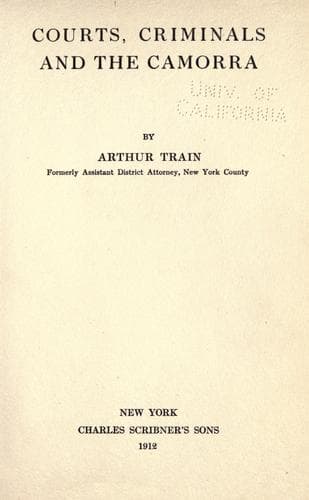
Courts, Criminals and the CamorraTrain, Arthur Cheney
History
Courts, Criminals and the Camorra
Train, Arthur Cheney
Camorra; Criminals -- United States; Justice, Administration of -- United States
Even _Americans_ have not been slow to avail themselves of Camorrist
methods. There is a sewing-machine company which sells its machines to
Italian families on the instalment plan. A regular agent solicits the
orders, places the machines, and collects the initial dollar; but the
moment a subscriber in Mulberry Street falls in arrears his or her name
is placed on a black list, which is turned over by this enterprising
business house to a “collector,” who is none other than the leading
Camorrist, “bad man,” or Black Hander of the neighborhood. A knock on
the door from his fist, followed by the connotative expression on his
face, results almost uniformly in immediate payment of all that is due.
Needless to say, he gets his _camorra_—a good one—on the money that
otherwise might never be obtained.
It is probable that we should have this kind of thing among the
Italians in America even if the Neapolitan Camorra and the Sicilian
Mafia had never existed, for it is the precise kind of crime that
seems to be spontaneously generated among a suspicious, ignorant, and
superstitious people. The Italian is keenly alive to the dramatic,
sensational, and picturesque; he loves to intrigue, and will imagine
plots against him when none exists. If an Italian is late for a
business engagement the man with whom he has his appointment will be
convinced that there is some conspiracy afoot, even if his friend
has merely been delayed by a block on the subway. Thus, he is a good
subject for any wily Iago that happens along. The Italians in America
are the most thrifty of all our immigrant citizens. In five years
their deposits in the banks of New York State amounted to over one
hundred million dollars. The local Italian crooks avail themselves of
the universal fear of the vendetta, and let it be generally known that
trouble will visit the banker or importer who does not “come across”
handsomely. In most cases these Black Handers are ex-convicts with a
pretty general reputation as “bad men.” It is not necessary for them
to phrase their demands. The tradesman who is honored with a morning
call from one of this gentry does not need to be told the object of
the visit. The mere presence of the fellow is a threat; and, if it
is not acceded to, the front of the building will probably be blown
out by a dynamite bomb in the course of the next six weeks—whenever
the gang of which the bad man is the leader can get around to it. And
the bad man may perhaps have a still badder man who is preying upon
_him_. Very often one of these leaders or bosses will run two or three
groups, all operating at the same time. They meet in the back rooms
of saloons behind locked doors, under pretence of wishing to play a
game of _zecchinetta_ unmolested, or in the gloaming in the middle of a
city park or undeveloped property on the outskirts. There the different
members of the gang get their orders and stations, and perhaps a few
dollars advance wages. It is naturally quite impossible to guess
Public-domain text, read in full here on John Shaqi.
Reviews
Reviews
No reviews yet
Be the first to share your thoughts on this work.
Elsewhere in the archive
Join the Discussion
Join the discussion
Sign in to leave a comment or review.
Sign InorCreate an account