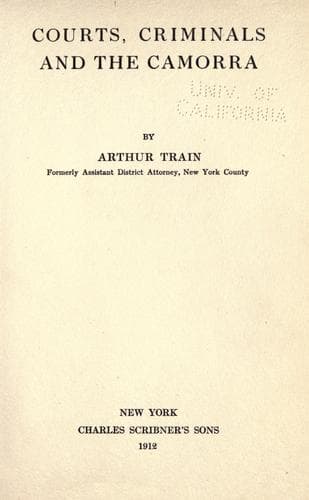
Courts, Criminals and the CamorraTrain, Arthur Cheney
History
Courts, Criminals and the Camorra
Train, Arthur Cheney
Camorra; Criminals -- United States; Justice, Administration of -- United States
In a moment the milkman was out of bed and gazing, with his wife, into
the street. They saw Rizzi come down with his tray and pass out of
sight. So did a couple of Italian detectives from Head-quarters who
had been following him and now, at his very heels, watched him enter
another tenement, take a bomb from his tray, and ignite a time fuse.
They caught him with the thing alight in his hand. Meanwhile the other
bomb had gone off and blown up the milkman’s tenement.
There is some ancient history in regard to these matters which ought to
be retold in the light of modern knowledge; for example, the case of
Patti, the Sicilian banker. He had a prosperous institution in which
were deposited the earnings of many Italians, poor and wealthy. Lupo’s
gang got after him and demanded a large sum for “protection.” But Patti
had a disinclination to give up, and refused. At the time his refusal
was attributed to high civic ideals, and he was lauded as a hero.
Anyhow, he defied the Mafia, laid in a stock of revolvers and rifles,
and rallied his friends around him. But the news got abroad that Lupo
was after Patti, and there was a run on Patti’s bank. It was a big run,
and some of the depositors gesticulated and threatened—for Patti
couldn’t pay it all out in a minute. Then there was some kind of a row,
and Patti and his friends (claiming that the Mafia had arrived) opened
fire, killing one man and wounding others. The newspapers praised Patti
for a brave and stalwart citizen. Maybe he was. After the smoke had
cleared away, however, he disappeared with all his depositors’ money,
and now it has been discovered that the man he killed was a _depositor_
and not a Black Hander. The police are still looking for him.
This case seems a fairly good illustration of the endless opportunity
for wrong-doing possible in a state of society where extortion is
permitted to exist—where the laws are not enforced—where there is a
“higher” sanction than the code. Whether Patti was a good or a bad man,
he might easily have killed an enemy in revenge and got off scot-free
on the mere claim that the other was blackmailing him; just as an
American in some parts of our country can kill almost anybody and rely
on being acquitted by a jury, provided he is willing to swear that the
deceased had made improper advances to his wife.
Public-domain text, read in full here on John Shaqi.
Reviews
Reviews
No reviews yet
Be the first to share your thoughts on this work.
Elsewhere in the archive
Join the Discussion
Join the discussion
Sign in to leave a comment or review.
Sign InorCreate an account