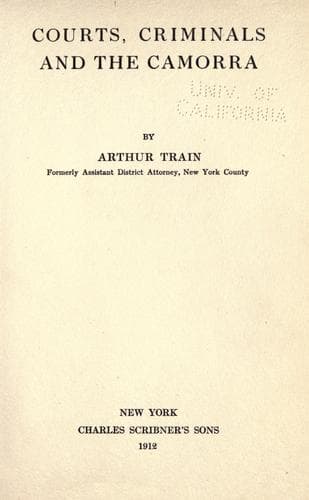
Courts, Criminals and the CamorraTrain, Arthur Cheney
History
Courts, Criminals and the Camorra
Train, Arthur Cheney
Camorra; Criminals -- United States; Justice, Administration of -- United States
the number of successful and unsuccessful attempts at blackmail
among Italians, as the amount of undiscovered crime throughout the
country at large is incomputable. No word of it comes from the lips
of the victims, who are in mortal terror of the vendetta—of meeting
some casual stranger on the street who will significantly draw the
forefinger of his right hand across his throat.
There is rather more chance to find and convict a kidnapper than a
bomb-thrower, so that, as a means of extortion, child-snatching is
less popular than the mere demand for the victim’s money or his life.
On the other hand it is probably much more effective in accomplishing
its result. But America will not stand for kidnapping, and, although
the latter occurs occasionally, the number of cases is insignificant
compared with those in which dynamite is the chief factor. In 1908,
there were forty-four bomb outrages reported in New York City. There
were seventy arrests and nine convictions. During the present year
(1911) there have been about sixty bomb cases, but there have been
none since September 8, since Detective Carrao captured Rizzi, a
_picciott’_, in the act of lighting a bomb in the hallway of a
tenement house.
This case of Rizzi is an enlightening one for the student of social
conditions in New York, for Rizzi was no Orsini, not even a Guy Fawkes,
nor yet was he an outlaw in his own name. He was simply a _picciott’_
(pronounced “pish-ot”) who did what he was told in order that some
other man who did know why might carry out a threat to blow up somebody
who had refused to be blackmailed. It is practically impossible to get
inside the complicated emotions and motives that lead a man to become
an understudy in dynamiting. Rizzi probably got well paid; at any rate,
he was constantly demonstrating his fitness “to do big things in a big
way,” and be received into the small company of the elect—to go forth
and blackmail on his own hook and hire some other _picciott’_ to set
off the bombs.
Whoever the _capo maestra_ that Rizzi worked for, he was not only
a deep-dyed villain, but a brainy one. The gang hired a store and
pretended to be engaged in the milk business. They carried the bombs in
the steel trays holding the milk bottles and cans, and, in the costume
of peaceful vendors of the lacteal fluid, they entered the tenements
and did their damage to such as failed to pay them tribute. The manner
of his capture was dramatic. A real milkman for whom Rizzi had worked
in the past was marked out for slaughter. He had been blown up twice
already. While he slept his wife heard some one moving in the hall.
Looking out through a small window, she saw the ex-employee fumble
with something and then turn out the gas on the landing. Her husband,
awakened by her exit and return, asked sleepily what the matter was.
“I saw Rizzi out in the hall,” she answered. “It was funny—he put out
the light!”
Public-domain text, read in full here on John Shaqi.
Reviews
Reviews
No reviews yet
Be the first to share your thoughts on this work.
Elsewhere in the archive
Join the Discussion
Join the discussion
Sign in to leave a comment or review.
Sign InorCreate an account