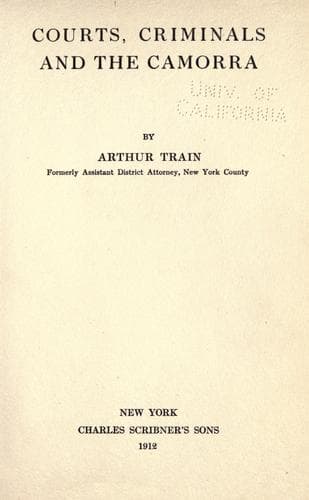
Courts, Criminals and the CamorraTrain, Arthur Cheney
History
Courts, Criminals and the Camorra
Train, Arthur Cheney
Camorra; Criminals -- United States; Justice, Administration of -- United States
Most Italian crooks come to the United States not merely some time or
other, but _at intervals_. Practically all of the Camorrist defendants
on trial at Viterbo have been in the United States, and all will be
here soon again, after their discharge, unless steps are taken to
keep them out. Luckily, it is a fact that so much has been written in
American newspapers and periodicals in the past few years about the
danger of the Black Hand and the criminals from south Italy that the
authorities on the other side have allowed a rumor to be circulated
that the climate of _South_ America is peculiarly adapted to persons
whose lungs have become weakened from confinement in prison. In fact,
at the present time more Italian criminals seek asylum in the Argentine
than in the United States. Theoretically, of course, as no convict can
procure a passport, none of them leave Italy at all—but that is one
of the humors of diplomacy. The approved method among the continental
countries of Europe of getting rid of their criminals is to induce them
to “move on.” A lot of them keep “moving on” until they land in America.
Of course, the police should be able to cope with the Black Hand
problem, and, with a free use of Italian detectives who speak the
dialects and know their quarry, we may gradually, in the course of
fifteen years or so, see the entire disappearance of this particular
criminal phenomenon. But an ounce of prevention is worth several tons
of cure. Petrosino claimed—not boastfully—that he could, with proper
deportation laws behind him, exterminate the Black Hand throughout the
United States in _three_ months.
But, as far as the future is concerned, a solution of the problem
exists—a solution so simple that only a statesman could explain why
it has not been adopted long years ago. The statutes in force at
Ellis Island permit the exclusion of immigrants who have been guilty
of crimes involving moral turpitude in their native land, but do
not provide for the compulsory production of the applicants’ “penal
certificate” under penalty of deportation. Every Italian emigrant is
obliged to secure a certified document from the police authorities
of his native place, giving his entire criminal record or showing
that he has had none, and without it he can not obtain a passport.
For several years efforts have been made to insert in our immigration
laws a provision that every immigrant from a country issuing such a
certificate _must_ produce it before he can be sure of admission to the
United States. If this proposed law should be passed by Congress the
exclusion of Italian criminals would be almost automatic. But if it or
some similar provision fails to become law, it is not too much to say
that we may well anticipate a Camorra of some sort in every locality
in our country having a large Italian population. Yet government moves
slowly, and action halts while diplomacy sagely shakes its head over
the official cigarette.
Public-domain text, read in full here on John Shaqi.
Reviews
Reviews
No reviews yet
Be the first to share your thoughts on this work.
Elsewhere in the archive
Join the Discussion
Join the discussion
Sign in to leave a comment or review.
Sign InorCreate an account