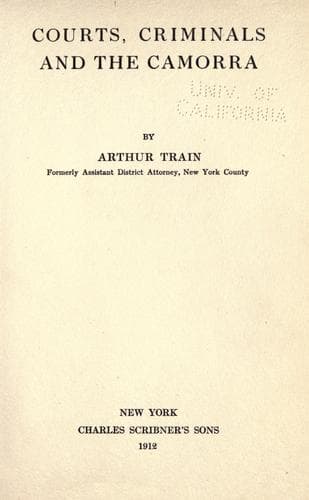
Courts, Criminals and the CamorraTrain, Arthur Cheney
History
Courts, Criminals and the Camorra
Train, Arthur Cheney
Camorra; Criminals -- United States; Justice, Administration of -- United States
A bill amending the present law to this effect has received the
enthusiastic approval of the immigration authorities and of the
President. At first the Italian officials here and abroad expressed
themselves as heartily in sympathy with this proposed addition to
the excluded classes; but, once the bill was drawn and submitted to
Congress, some of these same officials entered violent protests against
it, on the ground that such a provision discriminated unfairly against
Italy and the other countries issuing such certificates. The result of
this has been to delay all action on the bill which is now being held
in committee. Meanwhile the Black Hander is arriving almost daily, and
we have no adequate laws to keep him out.
APPENDIX
ANXIOUS for the actual facts, the writer asked an Italian
friend to secure an interview with Cavalier Tarantelli,
Questor of Florence, who for a long time was a functionary of
the Public Safety in Naples, and testified in this capacity,
at Viterbo, on August 9, 1911. In discussing the power of
the Camorra, the Questor, after having given it as his
opinion that the actual criminal organization had lost most
of its unity, said: “At present there exist what are called
‘_combricole di quartiere_’ (_conventicles of the quarters_)
small secret associations of ‘camorristi’ belonging to the
same quarter of Naples. Naturally the different _combricole_
in the different quarters of Naples assist each other, as
likewise do the different chiefs of the quarters. Perhaps
there is still a kind of hierarchy among the chiefs as
there may still exist a hierarchy among the ‘camorristi’ in
the different quarters. These ‘camorristi’ are, as a rule,
bad characters, whose chief characteristics are immorality
and overbearing insolence, and who live accordingly. They
impose upon women and get money out of them; they practice
usury; they receive and hide stolen things. Naples has now
a special and intense criminality. The ‘camorristi’ are
at present almost all habitual criminals. But the real
so-called ‘act of camorra’ (_atto d’camorra_) is _extortion_,
namely, a price imposed upon those who fear individual or
collective imposition, either occult or open, on the part
of the ‘Camorra.’ Every morning a ‘camorrista’ will go to
the shopkeepers and tradesmen of the quarter (_quartiere_)
and collect the price paid by him to be let alone. There
are instances even nowadays of people who go to the chief
‘camorrista’ of their quarter in order to have their persons
and property protected. This protection, however, is now more
apparent than real. For instance, it is much more difficult
now than it was formerly to find people who try to recover
stolen property by having recourse to the ‘Camorra’ rather
than to the police. The ‘camorristi’ are extremely numerous
in Naples; at funeral processions, for example, you may see
thousands of them. Songs are sung beneath the windows of
Public-domain text, read in full here on John Shaqi.
Reviews
Reviews
No reviews yet
Be the first to share your thoughts on this work.
Elsewhere in the archive
Join the Discussion
Join the discussion
Sign in to leave a comment or review.
Sign InorCreate an account