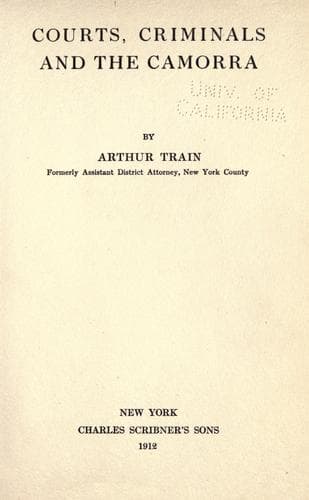
Courts, Criminals and the CamorraTrain, Arthur Cheney
History
Courts, Criminals and the Camorra
Train, Arthur Cheney
Camorra; Criminals -- United States; Justice, Administration of -- United States
prisons by the friends and relatives of the prisoners as a
means of communicating with the latter. But this custom of
‘the songs’ is now disappearing and the same may be said of
the ‘dichiaramenti’ (kinds of challenges), and of the tribunal
of the ‘Camorra.’ Some large meetings of ‘camorristi’ still
take place now and then. They will meet in some deserted
place in the country far away from the city or among the
mountains. I shall not deny that the judiciary of Naples is
somewhat different from that of Northern Italy. The former is
sometimes exceedingly indulgent, perhaps corrupt; that will
explain the influence of the ‘Camorra.’ It is no exaggeration
to state that magistrates in Naples are at times in awe of
the ‘camorristi,’ and especially of their friends who always
appear as perfectly honorable persons. It is a fact that the
police now endeavor to destroy the ‘Camorra,’ a thing which
they would not even have dreamt of a few years ago, and we
must not forget that the police consist for the most part of
men from the South of Italy. That there are officials and
agents taking bribes from secret associations for delinquency
is well known, but, of course, that does not occur in Naples
or in Italy alone. In Naples the ‘Camorra’ places itself
at the disposal of those who pay it, even in the case of
elections. As a rule, it is the candidates of the conservative
parties who avail themselves of the ‘Camorra.’ Thus, you see,
even ministers and prefects may avail themselves of it! At
all events, these deplorable facts are becoming less and less
frequent. Let us hope they may completely disappear! To the
Socialist party, however, must be given the credit of fighting
against the ‘Camorra’ to the best of its ability.”
This is an extraordinary admission for a public functionary
to make, and it is only fair to the Questor to state that his
interview was not made intentionally for publication. It is
what would be called in law an “admission against interest”
and is evidence of the weightiest character. One can read
between the lines that he but hints at the real state of
things. His opinion that the solidarity of the Camorra has
been greatly weakened seems to be borne out by many other
evidences. For example, the depositions of the informer
Abattemaggio are filled with detailed accounts of how various
local “camorristi” quarrelled over the division of their petty
spoils, tricked and cheated one another, and often betrayed
each other to the police. The day of the real camorrista,—he
of the swift dagger, the man of “heart,”—seems to be over
and to have given place to an era of filthy traders in vice,
petty grafters, blackmailers, and cheap thieves. But popular
imagination still surrounds these with the halo of romance and
regards the Camorra as “the friend of the people.”
FOOTNOTES.
[Footnote 1: Now abolished.]
[Footnote 2: In the State of New York.]
Public-domain text, read in full here on John Shaqi.
Reviews
Reviews
No reviews yet
Be the first to share your thoughts on this work.
Elsewhere in the archive
Join the Discussion
Join the discussion
Sign in to leave a comment or review.
Sign InorCreate an account