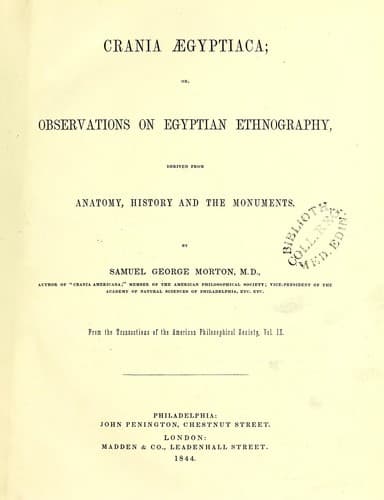
Crania Ægyptiaca: Or, Observations on Egyptian Ethnography Derived from Anatomy, History and the MonumentsMorton, Samuel George
History
Crania Ægyptiaca: Or, Observations on Egyptian Ethnography Derived from Anatomy, History and the Monuments
Morton, Samuel George
Craniology -- Egypt; Ethnology -- Egypt
_The Nose._—A review of the preceding Anatomical details, and a glance
at the accompanying delineations, will serve to show that the form of
the nose in the Caucasian series was straight, or slightly aquiline,
as in the Hindoo; more prominent, as in the Pelasgic tribes; and long,
salient, and aquiline, as in the Arabian race, and more especially in
the Semitic nations of that stock.
It may be here observed, that the nasal bones have in many instances
been more or less broken in forcing a passage through the ethmoid
bone, for the purpose of removing the brain. This operation, which
appears to have been almost uniformly practised at Thebes, was
comparatively unusual at Memphis; for of the twenty-six heads from the
latter necropolis, five only are perforated; while of the fifty-five
Theban crania, all are perforated but two; and in a third the ethmoid
is so little broken that the brain could not have been removed through
the orifice. I moreover detect three instances of complete perforation
of the nose, in which the brain had been extracted through the foramen
magnum, by cutting the neck half across behind; the bandages being
folded over the incision. The absence of the ethmoidal perforation in
the oldest heads from Memphis, and in many others of a later date from
the same necropolis, leads me to suppose that the brain may have been
primitively removed through the foramen magnum; and that its
extraction through the nose, as already suggested, may have been a
subsequent refinement of the embalming art. Again, the different
provinces of Egypt may have had peculiar and conventional details in
this as in other usages; for all the heads from Ombos and Maabdeh have
the ethmoidal opening; all those from Abydos and Debod are without it;
while of the four from Philæ, one is perforated and three are not.
Denon long ago pointed out a peculiarity of the Egyptian profile, as
seen in the remarkable distance between the nostrils and the teeth.
This feature, with a small receding chin, is of frequent occurrence
both in the mummies and on the monuments.
Public-domain text, read in full here on John Shaqi.
Reviews
Reviews
No reviews yet
Be the first to share your thoughts on this work.
Join the Discussion
Join the discussion
Sign in to leave a comment or review.
Sign InorCreate an account