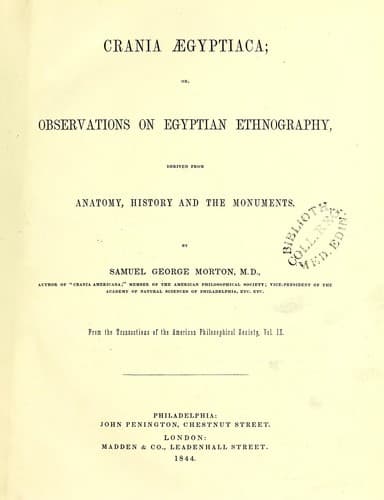
Crania Ægyptiaca: Or, Observations on Egyptian Ethnography Derived from Anatomy, History and the MonumentsMorton, Samuel George
History
Crania Ægyptiaca: Or, Observations on Egyptian Ethnography Derived from Anatomy, History and the Monuments
Morton, Samuel George
Craniology -- Egypt; Ethnology -- Egypt
Entering Africa by the Isthmus of Suez,[44] the children of Ham were
ushered into the fertile valley of the Nile, a region prepared by
nature for settled communities and a primeval civilization. In a
country bounded by the Red Sea on the one side, and by a wilderness on
the other, and presenting but a narrow strip of land for its
inhabitants, laws would at once become necessary for mutual
protection; and we may suppose that while one portion of the
Mizraimites embraced these social restrictions, another, impatient of
control, passed beyond the desert barrier on the west, and spreading
themselves over the north of Africa, became those nomadic tribes to
which the earliest annals give the name of LIBYANS.[45] It follows
from this view of the question, that we suppose the Egyptians and
Libyans to have been cognate people; that the former were the
aboriginal[46] inhabitants of the valley of the Nile; and that their
institutions, however modified by intrusive nations in after times,
were the offspring of their own minds.
It will, however, be very naturally objected that among the Egyptians
no gradations are apparent between barbarism and refinement, “It is a
remarkable fact,” says Sir G. Wilkinson, “that the first glimpse we
obtain of the history and manners of the Egyptians, shows a nation
already advanced in the arts of civilized life; and the same customs
and inventions that prevailed in the Augustan era of that people,
after the accession of the eighteenth dynasty, are found in the remote
age of Osortasen, the contemporary of Joseph.” How then could a branch
of the Libyan race, a people so comparatively obscure, have become the
mighty Egyptian nation? How could families of mankind so widely
different in their intellectual manifestations, have been derived from
a cognate stock? To which we reply, that the Egyptians and Libyans
were not in this respect more widely separated than were the Saracens
under the Caliphs, and the wandering Bedouins; yet, both these were
branches of the Arabian race. Egypt may perhaps be regarded as the
intellectual centre of the posterity of Ham.
Public-domain text, read in full here on John Shaqi.
Reviews
Reviews
No reviews yet
Be the first to share your thoughts on this work.
Join the Discussion
Join the discussion
Sign in to leave a comment or review.
Sign InorCreate an account