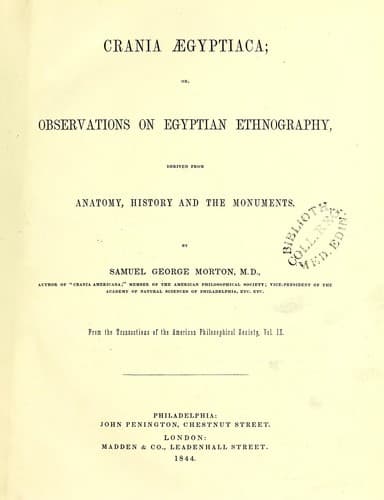
Crania Ægyptiaca: Or, Observations on Egyptian Ethnography Derived from Anatomy, History and the MonumentsMorton, Samuel George
History
Crania Ægyptiaca: Or, Observations on Egyptian Ethnography Derived from Anatomy, History and the Monuments
Morton, Samuel George
Craniology -- Egypt; Ethnology -- Egypt
The evidences of these opinions, it must be confessed, are as yet few
in number. That the Libyan or Berber speech was once the language of
all northern Africa has long been maintained by Ritter, Heeren and
Shaler, and by Mr. Hodgson in his very interesting Letters from
Algiers, during the period in which he held the United States
consulate in that regency.[47] Prof. Ritter (whose work I have not
seen) asserts that the Amazirgh, or Berber language, as detected by
certain prefixes and affixes peculiar to it and the Coptic tongue, is
to be found across the whole breadth of the continent, from the Red
Sea to the Canary Isles; and he supposes, too, that the Hazorta
tribes, like the old Bejas and modern Bishareens, were originally of
the same parent stock. To these evidences we may add those of Prof
Vater, who traced some affinity between the Berber and the Coptic and
Amharic, but not sufficient to lead to satisfactory results.
I have before me an obliging communication from Mr. Hodgson, in which
he informs me, that he also discovered what he believed to be
incontrovertible evidence of the Berber origin of the Bishareen
language, before he had read the work of Prof. Ritter; and in an essay
just published on the Foulahs of central Africa, he reiterates the
opinion early expressed by him, that the Berber or Libyan tongue was
spoken in the valley of the Nile, prior to the existence of the Coptic
or monumental language; a theory which, he further remarks, is in
accordance with the nature of things and the probable course of
events.
“Whilst the positive records of modern history,” observes Mr. Hodgson,
“show that the Coptic tongue has been obliterated from the map of
Egypt within the short period which has elapsed since the Saracenic
invasion, need we wonder that so few traces remain of the language of
that country in primeval and unrecorded times? These vestiges,
however, have been detected by me, and, I think, with a strong degree
of probability, in the mythologic and geographical names transmitted
to us from the earliest periods of Egyptian history. The meaning of
Ammon, Thebes, Themis, and Nile, and of Heliopolis (Tadij) and
Apollinopolis (Etfu) have been explained from the modern Berber
language; and the very name of _Hykshos_, who were called shepherds,
means also shepherds in Berber.[48]
“These etymologies serve, at least, as tokens of the existence of the
Libyans in the valley of the Nile, at a period anterior to that of the
monumental Egyptians. I have, also, found grammatical affinities
between the Coptic and the Berber, which suggest that the monosyllabic
elements of the former have been imposed upon the Berber syntax, and,
therefore, that the Coptic is posterior in nationality to the Berber.”
Public-domain text, read in full here on John Shaqi.
Reviews
Reviews
No reviews yet
Be the first to share your thoughts on this work.
Join the Discussion
Join the discussion
Sign in to leave a comment or review.
Sign InorCreate an account