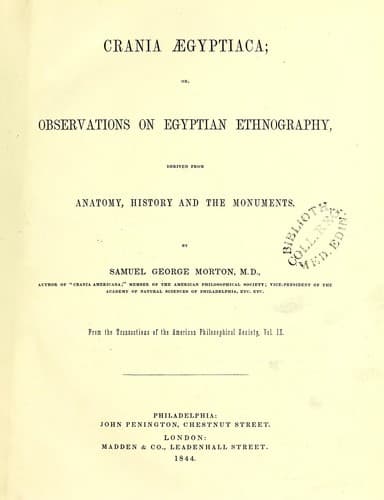
Crania Ægyptiaca: Or, Observations on Egyptian Ethnography Derived from Anatomy, History and the MonumentsMorton, Samuel George
History
Crania Ægyptiaca: Or, Observations on Egyptian Ethnography Derived from Anatomy, History and the Monuments
Morton, Samuel George
Craniology -- Egypt; Ethnology -- Egypt
The annexed head, (1) that of a reaper, is one of a great number
executed in bas-relief in the celebrated tombs of Eilethyas, which
possess a greater interest and value in ethnography on account of
their venerable antiquity; for they date with and before the
eighteenth dynasty, and consequently are at least three thousand six
hundred years old.[68] The great French work, (Déscription de
l’Egypte,) contains an extended series of illustrations from the same
remarkable tombs in which a similar cast of features is almost every
where apparent.[69]
[Illustration]
The same style of face is not less decidedly expressed in another head
(2) from Rosellini,[70] of which the original painting is preserved in
the Royal Gallery at Florence. It represents an artisan. How admirably
do the features conform to the Grecian type!
[Illustration]
I repeat the remark, and yet more emphatically, in reference to the
admirable battle scene at Abousimbel, of the age of Rameses the Third,
wherein eighty soldiers are depicted in a single group, each one
bearing a shield and spear.[71] Are they mercenaries from one of the
Hellenic tribes? I select the two subjoined examples; (3) for a close
resemblance pervades them all. Here again every line is Grecian; and
yet when these paintings were executed, the wandering Pelasgi had
hardly begun to associate themselves in civilized communities, and the
arts of Greece were unknown.
[Illustration]
Paintings of a similar ethnographic character are seen in profusion at
Beni-Hassan, whence is derived the annexed outline, representing one
of the leather-dressers of that group. The straight line for the nose
and forehead is strictly Pelasgic, and conforms in most respects to
the other facial traits. (4)
The same general physiognomy is often much more rudely expressed, as
in the tomb of Imai, at Gizeh, which is of the age of Shufo, of the
fourth dynasty, and consequently the period of disputed chronology.
Rude as these figures are, and identified with an humble sphere of
life, they have the Caucasian form, and partake of the same
ethnographic lineaments with the more elaborately finished
outlines delineated above. It may be observed, with respect to
Egyptian art, that while the bas-reliefs are for the most part
executed with remarkable beauty and precision, the paintings, owing to
the use of a single colour, and the absence of perspective or shading,
are often coarse and defective; and the two annexed drawings will
serve to illustrate this negligent style of art.
[Illustration]
Public-domain text, read in full here on John Shaqi.
Reviews
Reviews
No reviews yet
Be the first to share your thoughts on this work.
Elsewhere in the archive
Join the Discussion
Join the discussion
Sign in to leave a comment or review.
Sign InorCreate an account