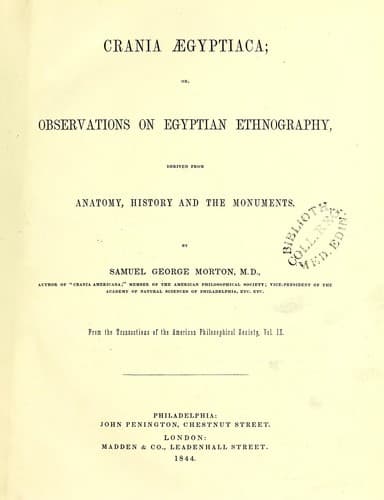
Crania Ægyptiaca: Or, Observations on Egyptian Ethnography Derived from Anatomy, History and the MonumentsMorton, Samuel George
History
Crania Ægyptiaca: Or, Observations on Egyptian Ethnography Derived from Anatomy, History and the Monuments
Morton, Samuel George
Craniology -- Egypt; Ethnology -- Egypt
It is thus that we trace the Pelasgic type of feature and expression
through all the various castes of the Egyptian population, beginning
with kings and ending with peasants and plebeians. The illustrations
have been purposely selected from those remote times wherein
chronology becomes confusion, down to the later periods of recorded
history,—a vast period of thirteen centuries, of which the latest date
looks back nine hundred years before the birth of Christ!
People of Pelasgic features and complexion are often seen on the
monuments as prisoners taken in war. One of these is copied, Plate
XIV., Fig. 23. It is from Abousimbel, and dates with Rameses III. The
very fair skin, regular features and black hair seem to point to a
nation of southern Europe. The nose is nearly straight, and on the
same line with the forehead, although the latter recedes more than is
consistent with our ideas of the Grecian profile.[72]
------------------------------------------------------------------------
3. THE SEMITIC RACE.[73]
That people of this great family were numerous in Egypt is amply
attested both by sacred and profane history; and the proximity of
their respective countries necessarily brought the Semitic and
Egyptian communities into frequent contact for war or for peace. This
fact is abundantly proved by the monuments. The Jewish people,
however, appears, for the most part, to have been admitted into Egypt
upon sufferance; for the Exodus, and all subsequent annals, are
conclusive on this subject.
Those peculiar lineaments which, from very remote times, have
characterized some of the Semitic nations, have been already noticed.
How many of these nations possessed these physical characters, cannot
now be determined; but it is probable that all partook of them in
degree. It is in the temple of Beyt-el-Wàlee, in Nubia, in paintings
of the age of Rameses II., (B.C. 1579,) that we meet with one of the
earliest unquestionable delineations of these people. (Plate XIV.,
Fig. 24.)
Public-domain text, read in full here on John Shaqi.
Reviews
Reviews
No reviews yet
Be the first to share your thoughts on this work.
Elsewhere in the archive
Join the Discussion
Join the discussion
Sign in to leave a comment or review.
Sign InorCreate an account