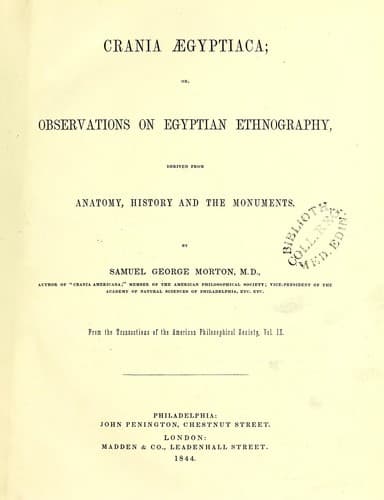
Crania Ægyptiaca: Or, Observations on Egyptian Ethnography Derived from Anatomy, History and the MonumentsMorton, Samuel George
History
Crania Ægyptiaca: Or, Observations on Egyptian Ethnography Derived from Anatomy, History and the Monuments
Morton, Samuel George
Craniology -- Egypt; Ethnology -- Egypt
An additional illustration is that given in the margin. It is also
preserved in the temple of Bey-el-Wàlee, and is of the same date as
the head above described. These people are generally represented as
enemies or bondsmen; nor have I any doubt that the figures in the
celebrated _Brickmaker’s scene_, in the tomb of Rekshari, at Thebes,
of the age of Thotmes IV., are those of a Semitic nation, and, in all
probability, Hebrews. Their features obviously correspond with those
of the latter people; and their scanty beards, which have been made an
objection to this view of their nationality, may be regarded as a
compulsory badge of captivity. Perhaps the most Hebrew _portrait_ on
the monuments is that of Aahmes-Nofre-Ari, Queen of Amunoph I., who is
said by the hieroglyphists to have been by birth a Meröite. (Plate
XIV., Fig. 13.) Semitic features, as we have already shown, are
occasionally found among the embalmed heads from the catacombs; in
proof of which I refer, with confidence, to Plate XI., Fig. 2; and
also, though less strongly marked, to Plate II., Fig. 8, Plate VI.,
Figs. 2 and 8, and to Plate XII., Figs. 1 and 2.
[Illustration]
My studies have not qualified me for philological comparisons and
inferences, but I cannot forbear introducing the following views of
the learned Dr. Lepsius, on account of their direct bearing upon this
interesting question. Speaking of the Egyptian and Coptic tongues, he
says:—“I have now discovered, in the essence of the language itself,
not only that there is no appearance whatever of any grammatical
change, and that it possesses, perhaps in a higher degree, that
principle of stability so peculiar to the Semitic dialects, but also
that it has preserved in its formation traces of a higher antiquity
than any Indo-Germanic or Semitic language wherewith I am acquainted,
which traces will therefore be most unexpectedly important even for
these two families. At the same time the Coptic cannot be termed
either Semitic or Indo-Germanic. It has its own peculiar formation,
though, at the same time, _its fundamental relationship with these two
families_ is not to be mistaken.”[74]
THE ARABS.—The southern or peninsular Arabs are a people of middle
stature, with a complexion varying from a sallow hue to a very dark
colour. They have sharp, bold features, a rather prominent face, and a
straight or gently aquiline nose. The head is, moreover, comparatively
small, and the forehead rather narrow and sensibly receding; to which
may often be added a meagre and angular figure,[75] long, slender
limbs, and large knees. Some tribes are also remarkable for the small
stature of the men, which, according to Burckhardt, does not exceed
five feet two or three inches; while, with a thick head of hair, they
possess a short, thin, and pointed beard.[76]
Public-domain text, read in full here on John Shaqi.
Reviews
Reviews
No reviews yet
Be the first to share your thoughts on this work.
Elsewhere in the archive
Join the Discussion
Join the discussion
Sign in to leave a comment or review.
Sign InorCreate an account