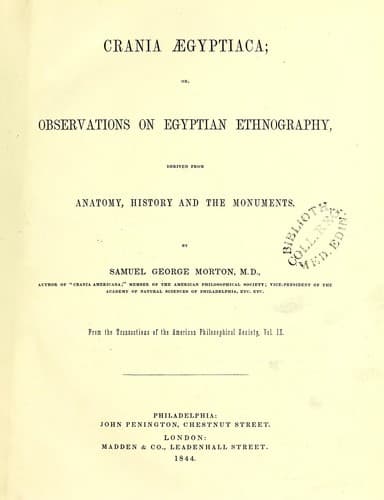
Crania Ægyptiaca: Or, Observations on Egyptian Ethnography Derived from Anatomy, History and the MonumentsMorton, Samuel George
History
Crania Ægyptiaca: Or, Observations on Egyptian Ethnography Derived from Anatomy, History and the Monuments
Morton, Samuel George
Craniology -- Egypt; Ethnology -- Egypt
Such are some of the Bedouins; but the most formidable Arab tribes
have always been the Hemyarites of Yemen; a restless and enterprising
people, whose migrations have been chiefly directed to Africa, and
especially to the valley of the Nile; a region which they have invaded
and more or less occupied from the earliest times, through the reigns
of the Pharaohs, Ptolemies, and Cæsars, down to a recent period of our
own era. What language can be stronger than that of Juba, (about the
commencement of our own era,) that the inhabitants of the valley of
the Nile, from Philæ to Meroë, were not Ethiopians, but Arabs? So,
also, in the days of Strabo, half the population of _Coptos_ itself
was made up of the same people.
The cranial resemblances between the Arabs and ancient Egyptians
impressed me forcibly from the commencement of my inquiries; which
last I have been able to prosecute in a more satisfactory manner by
means of a series of Arab skulls, obtained in Egypt by Mr. Gliddon. I
subjoin outline drawings of five of them, in order that the reader may
judge for himself.
[Illustration]
These skulls are all adult, and though comparatively small, give a
mean internal capacity of eighty-four cubic inches, which is above the
Egyptian average. The analogy, however, is greater in form than in
size, as may be observed by comparing the above outlines with several
of the embalmed heads from the catacombs, and especially that figured
Plate VI., Fig. 7. In fact, the resemblance between the Egyptian and
Arab head is so striking, that nothing but a faithful study of the
monuments has satisfied me that the two nations were primitively
distinct from each other; and that what I at first believed to be the
_Austral-Egyptian_ conformation, is no other than the Egyptian itself.
Some very ancient paintings, copied by Rosellini from the temple
decorations at Beyt-el-Wàlee, in Nubia, appear, also, to pertain to
the Arab physiognomy. (Plate XIV., Figs. 19, 20.) In these the
yellowish-red complexion indicates, we might suppose, some affinity
with the Egyptian nation, while the small, pointed beard, and sharp,
prominent face, point to the Arabian stock of nations. Their name
reads _Tohen_ on the monuments; and they pertain to the age of Rameses
II., and illustrate the conquests of that monarch 1579 years before
Christ.
Public-domain text, read in full here on John Shaqi.
Reviews
Reviews
No reviews yet
Be the first to share your thoughts on this work.
Elsewhere in the archive
Join the Discussion
Join the discussion
Sign in to leave a comment or review.
Sign InorCreate an account