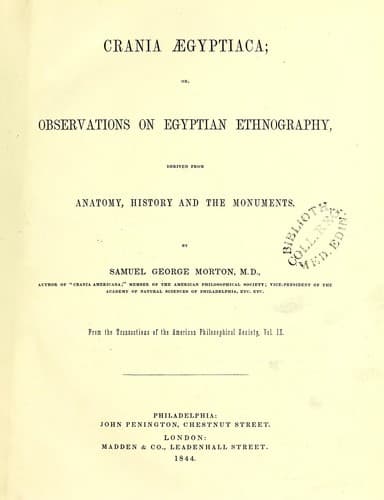
Crania Ægyptiaca: Or, Observations on Egyptian Ethnography Derived from Anatomy, History and the MonumentsMorton, Samuel George
History
Crania Ægyptiaca: Or, Observations on Egyptian Ethnography Derived from Anatomy, History and the Monuments
Morton, Samuel George
Craniology -- Egypt; Ethnology -- Egypt
Without entering into a philological discussion, it is worthy of
remark, that the Gheez or Ethiopic language, the oldest of the known
tongues of Abyssinia, is directly allied to the Arabic and Hebrew. The
period of its introduction into Africa is unknown, though it probably
dates far beyond our era. Moreover, among the ruins recently
discovered at Hasan Ghorâb, (170 miles east of Aden,) at Sanaa, and at
other places in Yemen, inscriptions have been abundantly found in the
old Ethiopic tongue, which, in the opinion of the late Professor
Gesenius, is a modification of the parent Hemyarite language.
These few facts, with others which will be adduced hereafter, go to
prove that the Egyptian people must have been more or less blended
with the Arabian race; nor can there be a question that the Meröite or
Austral-Egyptian communities were composed, at least in part, of an
Indo-Arabian stock engrafted on the aboriginal Libyan population.
An able but anonymous author not only asserts the Arab origin of the
monumental Ethiopians, but endeavours to prove, by an ingenious series
of facts and reasonings, that they were the “Blemies of history, a
Bejáwy branch of the Arabian family;” that they were broken and
finally dispersed by the policy of the Roman government, which, in the
reign of Dioclesian, introduced Negro colonies from Kordofan; and,
finally, that the Nubians of our day are not, as a nation, descended
from the ancient stock. The last proposition, as a general rule, is
undeniable; but the preceding conclusions are not yet susceptible of
proof.[77]
Convinced as we are that the Egyptians were a distinct and aboriginal
people, the sentiment of M. Jomard may yet become, to a certain
extent, an axiom in ethnography:—“L’Arabie à été de tout temps, et
elle est encore de nos jours, l’aliment de la population
Egyptienne.”[78]
------------------------------------------------------------------------
4. THE HINDOOS.
I observe among the Egyptian crania, some which differ in nothing from
the Hindoo type either in respect to size or configuration. I have
already, in my remarks upon the ear, mentioned a downward elongation
of the upper jaw, which I have more frequently met with in Egyptian
and Hindoo heads than in any others, although I have seen it
occasionally in all the races. This feature is remarkable in two of
the following five crania, (A, B,) and may be compared with a similar
form from Abydos. (Plate V., Fig. 2.)
[Illustration]
Public-domain text, read in full here on John Shaqi.
Reviews
Reviews
No reviews yet
Be the first to share your thoughts on this work.
Elsewhere in the archive
Join the Discussion
Join the discussion
Sign in to leave a comment or review.
Sign InorCreate an account