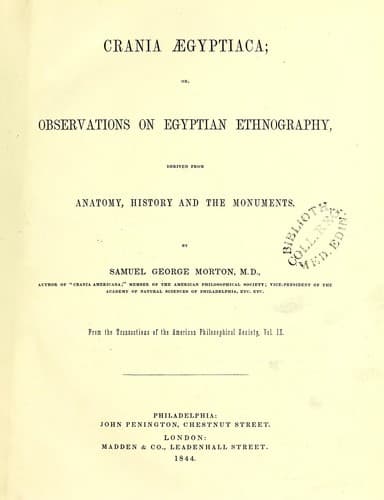
Crania Ægyptiaca: Or, Observations on Egyptian Ethnography Derived from Anatomy, History and the MonumentsMorton, Samuel George
History
Crania Ægyptiaca: Or, Observations on Egyptian Ethnography Derived from Anatomy, History and the Monuments
Morton, Samuel George
Craniology -- Egypt; Ethnology -- Egypt
It has been proved by the philosophic Heeren, that Meroë was the grand
emporium of the trade between the richest and most productive portions
of the earth; the gold countries of eastern Africa, the spice lands of
India, and the region of frankincense and precious stones in southern
Arabia. He has shown that the communication between these countries
was established in the most ancient periods, and continued without
interruption through successive ages of time; that the ruins of Adulé,
Azab, and Axum, yet mark the caravan routes between Meroë and Arabia
Felix; and that Yemen, though separated from India by an open sea, is
yet connected with it by nature in an extraordinary manner. “One half
of the year,” he adds, “from spring to autumn, the wind regularly sets
in and wafts the vessels from Arabia to India; the other half, from
autumn to spring, it as regularly carries them back from India to
Arabia.”[86]
In truth, what Diodorus says, in general, of early Egyptian commerce
and conquest by sea, need be no longer regarded as fabulous, although
the details, like much that we glean from the remote history of all
heathen nations, are to be received with circumspection. He tells us
that Sesostris (Rameses III.) fitted out a fleet of four hundred ships
in the Arabian gulf, with which he conquered all the countries
bordering on the Erythrean sea, as far as India, whence he led an army
beyond the Ganges until he again reached the ocean. This account is
not likely to be _all_ fable, especially since it comes from a Greek
historian; and we may safely regard it as an indication of that
extensive maritime enterprise in which the Egyptians engaged with the
southern nations of Asia. When the Romans under the guidance of
Hippalus, eighty years after their conquest of Egypt, began to trade
with India by way of the Red Sea and Malabar, they only re-established
the ancient route, which had been long forgotten amidst the chaos of
political revolutions. In fine, if the Egyptians had been their own
historians, we should probably learn that they were as familiar with
India in ancient as the English are in modern times.[87]
While we conclude, therefore, that the Egyptians were a distinct
people from either the Arabs or Hindoos, we cannot deny those
resemblances which are too obvious to be mistaken, yet not to be
accounted for without difficulty; nor can there be a reasonable doubt
that the people of both these nations formed an important part of the
once multitudinous population of Egypt.[88]
------------------------------------------------------------------------
5. THE HYKSHOS.
Public-domain text, read in full here on John Shaqi.
Reviews
Reviews
No reviews yet
Be the first to share your thoughts on this work.
Elsewhere in the archive
Join the Discussion
Join the discussion
Sign in to leave a comment or review.
Sign InorCreate an account