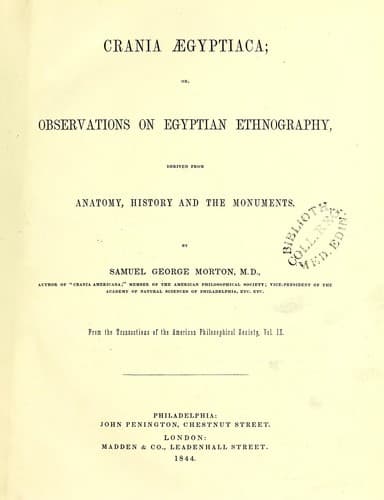
Crania Ægyptiaca: Or, Observations on Egyptian Ethnography Derived from Anatomy, History and the MonumentsMorton, Samuel George
History
Crania Ægyptiaca: Or, Observations on Egyptian Ethnography Derived from Anatomy, History and the Monuments
Morton, Samuel George
Craniology -- Egypt; Ethnology -- Egypt
That there was extensive and long-continued intercourse between the
Hindoos and Egyptians is beyond a question; and history speaks, also,
of conquest and migration. Which was primitively the dominant power?
The Egyptians very naturally decided this point in their own favour;
for they assert that Osiris crossed Arabia to the utmost inhabited
parts of India, and built many cities there. “He left, likewise,” says
Diodorus, “many other marks of his being in these parts, which have
induced the inhabitants to believe and affirm, that this god (Osiris)
was born in India.”[83] Thus it appears that, in the age of Diodorus,
the Hindoos not only worshipped, but claimed as original to
themselves, the principal divinity of the Egyptians. There is,
moreover, a passage in Syncellus which directly asserts that the
Hindoos, who, as we have observed, are sometimes called Ethiopians in
ancient history, formed colonies in Egypt. “Æthiopes ab Indo fluvio
profecti, supra Ægyptum sedem sibi eligerunt.” Heeren, from whom I
derive this quotation, remarks, that as the Hindoos would necessarily
arrive by sea, they would establish themselves on the coast. We grant
it; but a commercial and migratory people would soon find their way to
the great mart of Meroë, and thence to every part of the Egyptian
provinces. It has been observed by Mr. Bonomi, that the affiliation of
the Hindoos with the people of the upper Nile is confirmed by the
affinity which exists between the Ethiopic and Sanscrit systems of
writing, as pointed out by Dr. Wall and Mr. Tudor.[84]
Dr. Prichard, whose profound investigations into this and all other
questions in ethnography, command our highest respect, while he admits
that great difficulties present themselves in the present inquiry,
remarks “that a common origin, if not of the races themselves, at
least of the mental culture characteristic of both of them, has been
proved; and that the people of India and of Egypt derived from one
source the first principles of all their peculiarities of thought and
action, of their religious and social observances, and civil and
political institutions; and that these principles had even been
developed to a considerable extent, before the nations themselves were
entirely cut off from communication with each other or with a common
centre.”[85]
Public-domain text, read in full here on John Shaqi.
Reviews
Reviews
No reviews yet
Be the first to share your thoughts on this work.
Elsewhere in the archive
Join the Discussion
Join the discussion
Sign in to leave a comment or review.
Sign InorCreate an account