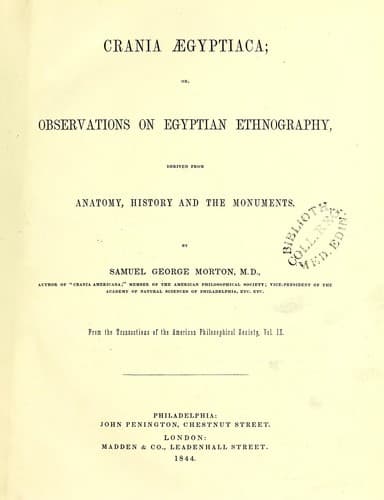
Crania Ægyptiaca: Or, Observations on Egyptian Ethnography Derived from Anatomy, History and the MonumentsMorton, Samuel George
History
Crania Ægyptiaca: Or, Observations on Egyptian Ethnography Derived from Anatomy, History and the Monuments
Morton, Samuel George
Craniology -- Egypt; Ethnology -- Egypt
A. Pyramid of five steps.
B. Saccàra, generally.
C. Front of the Brick Pyramid of Dashour.
D. North-west of the Pyramid of Five Steps.
E. Toora, on the Nile.
Second series, from the Grottoes of Maabdeh.
Third series, from Abydos.
Fourth series, from the Catacombs of Thebes.
Fifth series, from Koum Ombos.
Sixth series, from the Island of Beggeh, near Philæ.
Seventh Series, from Debod in Nubia.
------------------------------------------------------------------------
FIRST SERIES.
TWENTY-SIX SKULLS FROM THE NECROPOLIS OF MEMPHIS.
This vast Necropolis extends from the Pyramids of Gizeh to the
southern limit of Saccàra, a distance of about fifteen miles. The
tombs are cut in the solid rock, and frequently communicate with one
another, forming a vast subterranean labyrinth. Memphis is well known
to be one of the oldest, if not indeed the oldest of the Egyptian
cities; and among the tombs now extant Professor Rosellini has found
some which bear inscriptions of a date nearly 2300 years before
Christ, at which period Memphis must have been a large and flourishing
city. The simpler catacombs were probably constructed before the
pyramids; for these last could only result from centuries of
civilization, and next to the catacombs, are the oldest existing
monuments of the human race.
A.—FROM THE PYRAMID OF FIVE STEPS.
In the month of August, 1839, Mr. J. S. Perring, the distinguished
Engineer, discovered a _fourth_ entrance to this pyramid, which was
found to communicate with a recess at the south-western corner of a
large apartment described in his narrative. This communication is a
horizontal gallery one hundred and sixty-six feet long, and the recess
is seventy feet above the floor. “The southern end of the gallery,”
observes Colonel Vyse, “was stopped up with sand; but for the length
of one hundred and sixty feet from the interior it was open, and did
not seem to have been previously visited, as nearly thirty mummies
were found in it apparently undisturbed. They had neither coffins nor
sarcophagi, nor, with the exception of three or four, any painted
decorations. They crumbled to pieces on being touched, and could not
be removed. Mr. Perring, therefore, proceeded to examine them. He
found them enclosed in wrappers, with pitch and bitumen; but he did
not meet with any of the objects usually deposited with mummies,
excepting some of the common stone idols upon the body of the female.
He therefore concluded that they were the bodies of persons employed
in the building.”[2]
Public-domain text, read in full here on John Shaqi.
Reviews
Reviews
No reviews yet
Be the first to share your thoughts on this work.
Join the Discussion
Join the discussion
Sign in to leave a comment or review.
Sign InorCreate an account