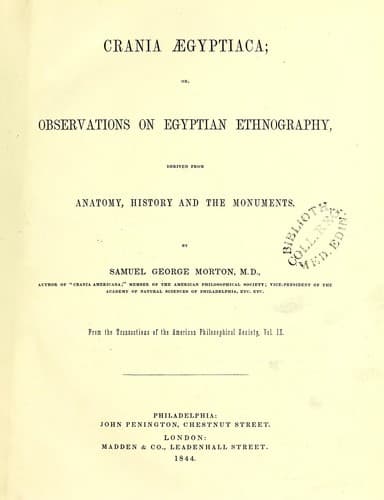
Crania Ægyptiaca: Or, Observations on Egyptian Ethnography Derived from Anatomy, History and the MonumentsMorton, Samuel George
History
Crania Ægyptiaca: Or, Observations on Egyptian Ethnography Derived from Anatomy, History and the Monuments
Morton, Samuel George
Craniology -- Egypt; Ethnology -- Egypt
No. 3. Another effigy of the same king, from the grottoes of El Tell,
of which Mr. Perring remarks, that having been copied in haste it is
somewhat in caricature.
El Tell, or Tel-el-Amarna, appears to have been the stronghold of
these “foreign marauders,” respecting whom Mr. Gliddon, after
suggesting the probability that the sovereigns may have been of
Arabian origin, inquires—“whether the present inhabitants, whose
village occupies the once warlike camp or city of _Atenre_, have in
their views and in their physical conformation, some vestiges of that
early tribe of heterodox conquerors? And may not then the cause of the
almost instinctive terror with which the natives of other parts of
Egypt regard this vicinity, proceed from vague traditions of ancient
predatory habits,—some fitful legend that has outlived thirty-five
centuries?”[91]
[Illustration]
There are many effigies of the same general character of the age of
the fourth Rameses. One of them, a captive, is figured in the margin.
Wilkinson reads their name Tochari on the monuments; Rosellini
translates it Fekkaro. To my view they have the lined and hardy
features of the Celts or Gauls, of whom, however, we have little
knowledge at that remote date, (B.C. 1400,) although even then they
occupied a large part of southern Europe. They perhaps rather pertain
to the Phenician branch of the Caucasian race.
[Illustration]
There are other paintings, especially some at Abousimbel of the age of
Rameses III., which correspond in every particular with the Scythian
physiognomy as recorded in history;[92] and the name of _Scheto_, by
which they are designated on the monuments, confirms the suggestion of
the hieroglyphists that they represent a Scythian or Scytho-Bactrian
people.[93]
The researches of Lord Lindsay seem to prove that the Assyrians were
also among the Hykshos conquerors of Egypt; and the shepherds who
invaded Egypt before the time of Abraham are called _Cushim_ by the
ancients, which means Ethiopians or Babylonians; for the country on
both sides of the Persian Gulf was called _Cush_.[94]
Plutarch, quoting Manetho, asserts that Tiphonean or red-haired men
were sacrificed in the temples of Eletheias, and their ashes scattered
to the winds. Was this done in commemoration of the hatred which the
Egyptians bore to the red-haired Hykshos?
------------------------------------------------------------------------
6. THE COPTS.
From various antecedent remarks it will be perceived that I regard the
Copts as a mixed community, derived in diverse proportions from the
Caucasian and the Negro; and this diversity of origin may explain the
dissimilar characteristics which travellers have ascribed to them.
Public-domain text, read in full here on John Shaqi.
Reviews
Reviews
No reviews yet
Be the first to share your thoughts on this work.
Elsewhere in the archive
Join the Discussion
Join the discussion
Sign in to leave a comment or review.
Sign InorCreate an account