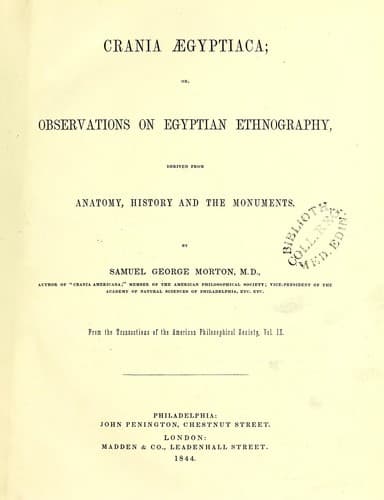
Crania Ægyptiaca: Or, Observations on Egyptian Ethnography Derived from Anatomy, History and the MonumentsMorton, Samuel George
History
Crania Ægyptiaca: Or, Observations on Egyptian Ethnography Derived from Anatomy, History and the Monuments
Morton, Samuel George
Craniology -- Egypt; Ethnology -- Egypt
Denon, for example, described them as having “flat foreheads, eyes
half closed, and raised up at the angles, high cheek bones, a broad,
flat, and short nose, a large, flattened mouth, placed at a
considerable distance from the nose, thick lips, a little beard, a
shapeless body, crooked legs, without expression in the contour, and
long, flat toes.”[95] Denon even thinks that these features
correspond, in a remarkable manner, with the human face and figure as
represented in Egyptian painting and sculpture! And Sonnini, after
describing them in nearly analogous terms, adds the moral reproach,
that while “they are the ugliest of men, they are the filthiest and
most disgusting.”[96]
If we compare these seemingly exaggerated descriptions with those of
Brown, Lane, and some other travellers, the discrepancy is so great
as, at first thought, to baffle all explanation. Brown, for example,
“was not struck with any resemblance to the Negro features or form;”
and he saw nothing remarkable in the texture of the hair.[97] “The
eyes of the Copts,” says Mr. Lane, “are generally large and elongated,
slightly inclining from the nose upwards, and always black. The nose
is straight, excepting at the end, where it is rounded and wide; and
the lips are rather thick, and the hair is black and curly.”[98]
Madden adds that they are characterized by a remarkable distance
between the eyes. Belzoni observed among them some as fair as
Europeans; Rosellini assures us that they are largely mixed with
Jewish and Roman blood;[99] and D’Avezac, like Depauw, discovers in
them a partial Chinese ancestry. These, and numberless other opinions
which might be cited, prove that the Copts differ greatly among
themselves; and that they are, physically and morally, a mixture of
all the nations which have successively held dominion in Egypt, or
swelled its varied population—Egyptians of various castes, Greeks,
Romans, Arabs, Hebrews, Negroes, and some others Such was, at least in
part, the opinion of Pugnet, (whose memoir I have not seen,) for he
separates them “into two divisions; those whose ancestry has been
intermixed, and partly of Greek and Latin descent, and a class of
purely Egyptian origin.”[100] But, after all, perhaps the traces which
are most invariable in the Copt are derived from the Negro; and they
are manifest in the very bones of the head and face.
Public-domain text, read in full here on John Shaqi.
Reviews
Reviews
No reviews yet
Be the first to share your thoughts on this work.
Elsewhere in the archive
Join the Discussion
Join the discussion
Sign in to leave a comment or review.
Sign InorCreate an account