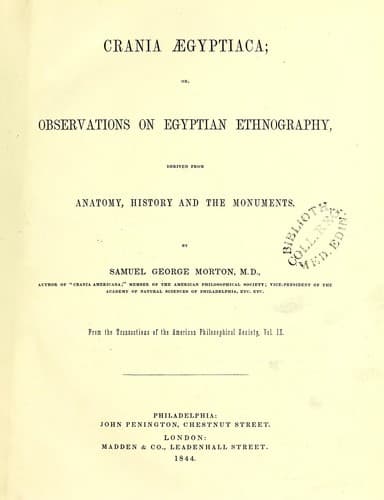
Crania Ægyptiaca: Or, Observations on Egyptian Ethnography Derived from Anatomy, History and the MonumentsMorton, Samuel George
History
Crania Ægyptiaca: Or, Observations on Egyptian Ethnography Derived from Anatomy, History and the Monuments
Morton, Samuel George
Craniology -- Egypt; Ethnology -- Egypt
It seems necessary, in further elucidation of this subject, to submit
a few additional facts and observations in reference to the Berbers,
or present inhabitants of Nubia, in order to show their relative
position to the ancient occupants of that country. As the celebrated
Burckhardt saw them in almost every locality, we shall mainly content
ourselves with his graphic delineation. The Berbers, says he, are of a
dark red-brown complexion, “which, if the mother is a slave from
Abyssinia, becomes a light brown in the children; and if from the
Negro countries, extremely dark. Their features are not at all those
of the Negro, the face being oval, the nose often perfectly Grecian,
and the cheek bones not prominent. The upper lip, however, is somewhat
thicker than is considered beautiful among northern nations, though it
is still far from the Negro lip. Their hair is bushy and strong, but
not woolly.” The same intelligent traveller subsequently speaks of
their language, respecting which he was certainly well qualified to
judge; he assures us that the people south of Siout are ancient
Bedouin tribes, who speak a very pure Arabic; and he makes a nearly
similar remark respecting those who inhabit the river banks from
Dongola to Senaar, and thence westward to Bornou, although they speak
many different dialects.[103]
It is well known, however, that there are whole tribes in Nubia whose
language is not derived from the Arabic; and these may be more nearly
allied to the primitive population. “The inhabitants of Dar Dongola,”
says Dr. Rüppell, “are divided into two principal classes, namely, the
Barábra, or _descendants of the old Ethiopian natives of the country_,
and the races of Arabs who have emigrated from the Hedjar. The
ancestors of the Barábra, who, in the course of centuries have been
repeatedly conquered by hostile tribes, must have undergone some
intermixture with people of foreign blood; yet an attentive inquiry
will enable us to distinguish among them the old national physiognomy
which their forefathers have marked upon colossal statues, and the
bas-reliefs of temples and sepulchres. A long, oval countenance, a
beautifully curved nose, somewhat rounded towards the tip,
proportionately thick lips, but not protruding excessively, a
retreating chin, scanty beard, lively eyes, strongly frizzled but
never woolly hair, a remarkably beautiful figure, generally of middle
size, and a bronze colour, are the characteristics of the genuine
Dungolawi.”[104] He adds, that the same traits of physiognomy are
generally found among the Ababdé, the Bishareen, and partially among
the people of Shendy and Abyssinia.
Public-domain text, read in full here on John Shaqi.
Reviews
Reviews
No reviews yet
Be the first to share your thoughts on this work.
Elsewhere in the archive
Join the Discussion
Join the discussion
Sign in to leave a comment or review.
Sign InorCreate an account