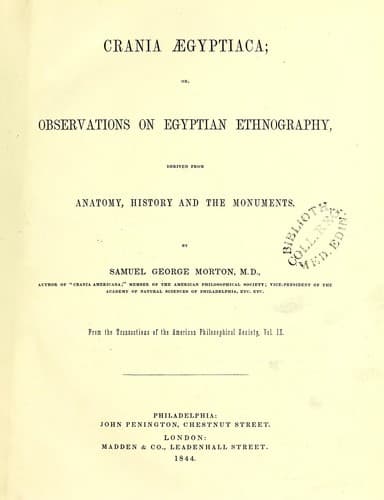
Crania Ægyptiaca: Or, Observations on Egyptian Ethnography Derived from Anatomy, History and the MonumentsMorton, Samuel George
History
Crania Ægyptiaca: Or, Observations on Egyptian Ethnography Derived from Anatomy, History and the Monuments
Morton, Samuel George
Craniology -- Egypt; Ethnology -- Egypt
It must be acknowledged, however, that we can hardly expect to find
the genuine Egypto-Ethiopian lineaments in any considerable number
among the modern Nubians. Placed as the former were, between the
Egyptians on the north, the Indo-Arabian nations on the east, and the
Negroes on the south and west, and this, too, through the long period
of several thousand years, their features must have become sensibly
modified, even in the earliest times, by that blending of race which
was inseparable from their position; and as the Koldagi and other
Negro tribes have, at different times, established themselves in large
bodies in Nubia, we need be at no loss, I conceive, in accounting for
any traces of Negro lineage in some Barábra communities of the present
day.
Dr. Prichard considers “the descent of the modern Nubians, or Barábra,
from the Nouba (a Negro nation) of the hill country of Kordofan, to be
as well established as very many facts which are regarded as certain
by writers on ethnography.” With every deference to that distinguished
ethnographer, we may inquire, what became of the pre-existing
inhabitants when the tribes of Kordofan colonized Nubia? Were they
destroyed or expelled? History makes no mention of either; and we are
justified in the opinion that an amalgamation of races took place,
whence some of those diversities of organization observable in the
modern Nubians. That this intermixture of races has continued to the
present time, the reader will find abundant evidence in other parts of
this memoir; yet I cannot here refrain from adding an observation from
Cailliaud, who, remarking on the shortness of life among the people of
Senaar from disease and dissipation, declares that the number of
Negroes which pours into the country, and the fruitfulness of the
women, are the resources which serve to repair the vast and continual
waste of population.[105] I may be told that this is proving too much.
A sensible writer, and one who has ingeniously and instructively
investigated the Nubian question, remarks as follows:—“The Arab tribes
near Shendy may still, perhaps, justly boast of the purity of their
blood; but, generally speaking, within the limits mentioned above, the
slave or Negro population is about a sixth of the whole, and
continually amalgamating with it. While nature kindly endeavours to
wash out the stain, every caravan from the south or west pours in a
new supply of slaves, and restores the blackening element.”[106]
Public-domain text, read in full here on John Shaqi.
Reviews
Reviews
No reviews yet
Be the first to share your thoughts on this work.
Elsewhere in the archive
Join the Discussion
Join the discussion
Sign in to leave a comment or review.
Sign InorCreate an account