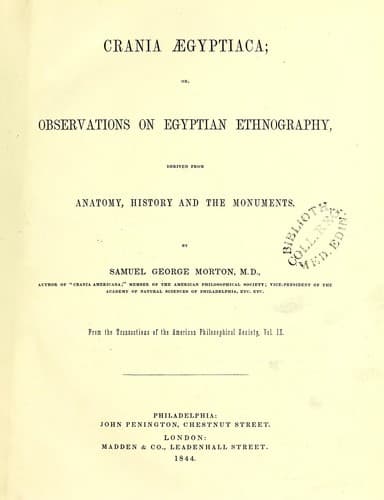
Crania Ægyptiaca: Or, Observations on Egyptian Ethnography Derived from Anatomy, History and the MonumentsMorton, Samuel George
History
Crania Ægyptiaca: Or, Observations on Egyptian Ethnography Derived from Anatomy, History and the Monuments
Morton, Samuel George
Craniology -- Egypt; Ethnology -- Egypt
This vast influx of Negroes into the valley of the Nile must
necessarily have left its impression on the physical traits of the
Egyptians themselves; in modern times, as seen in the Copts, and in
more distant periods, as proved by the Negroid heads, in which both
the configuration and expression are too obvious to be mistaken. But
it may be inquired, how does it happen that Negroes or their
descendants should be found in the catacombs, if they constituted a
menial or slave-caste in Egypt? In reply, it may be observed that
persons of this race have been capable, in all ages, of elevating
themselves to posts of distinction in the east, and especially and
proverbially those who have belonged to the class of eunuchs.[110] It
is also important to observe, that so tenacious were the Egyptians of
the rights of their offspring, that they admitted them to equal
privileges with themselves, _even when the mother was a slave_; and
these usages extended to inheritance.[111]
The preceding facts, without multiplying more on the same subject,
amply account for that interminable amalgamation of the Caucasian and
Negro races which has been going on in Egypt from the remotest times;
while they also explain that incidental social elevation of the Negro
caste, to which the monuments and catacombs alike bear witness.
This blending of races is farther illustrated in the present
population of Nubia. The traveller Burckhardt remarks, that the slaves
sent down the Nile, and those transported to Arabia, bear but a small
proportion to the number kept by the Mahommedans of the more southern
countries of Africa. At Shendy, for example, from one to six are seen
in every family; and the custom prevails as far as Senaar, and
westward to Kordofan, Darfour and Bornou. All the Bedouin tribes who
inhabit or surround these countries are well stocked with slaves, nor
does the number diminish in the very remote provinces of Houssa and
Begarmeh; and we are told by the same intelligent observer, that the
result of this promiscuous intercourse is a mixed progeny, which
blends the characteristics of the Arab with those of the Negro.[112]
Negroes are abundantly represented on the pictorial delineations of
the Egyptian monuments of every epoch. Complexion, features, and
expression, these and every other attribute of the race, are depicted
precisely as we are accustomed to see them in our daily walks: indeed,
were we to judge by the drawings alone, we might suppose them to have
been executed but yesterday; and yet some of these vivid delineations
are nearly three thousand five hundred years old! and, moreover, as if
to enforce the distinction of race by direct contrast, they are placed
side by side with people of the purest Caucasian features.
Public-domain text, read in full here on John Shaqi.
Reviews
Reviews
No reviews yet
Be the first to share your thoughts on this work.
Elsewhere in the archive
Join the Discussion
Join the discussion
Sign in to leave a comment or review.
Sign InorCreate an account