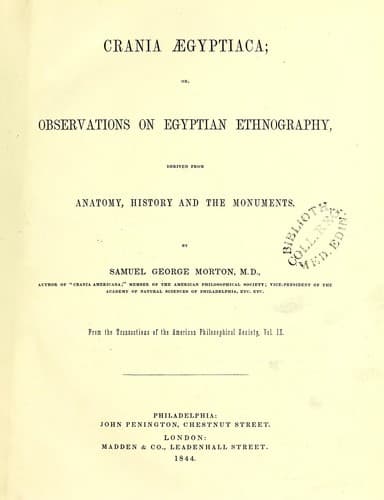
Crania Ægyptiaca: Or, Observations on Egyptian Ethnography Derived from Anatomy, History and the MonumentsMorton, Samuel George
History
Crania Ægyptiaca: Or, Observations on Egyptian Ethnography Derived from Anatomy, History and the Monuments
Morton, Samuel George
Craniology -- Egypt; Ethnology -- Egypt
This author, however, in his desire to ascribe to climate the chief
agency in the transformation of the Negro into the Nubian, seems to
overlook the fact that while the Negroes flow into the country on the
one side, the migratory Arabs invade it on the other, thus furnishing
inexhaustible materials for the blending of the two races. I fully
acquiesce, as before hinted, in the accuracy of the following opinion,
as applied to a large proportion of the modern Nubians; namely, “that
they are descended, not from the possessors of Ethiopia in its
flourishing period, but from the prædial and slave population of the
country, increased by colonists, and raised into a nation by peculiar
circumstances between the third and sixth centuries of the Christian
era.”[107]
------------------------------------------------------------------------
8. THE NEGROES.
We have the most unequivocal evidence, historical and monumental, that
slavery was among the earliest of the social institutions of Egypt,
and that it was imposed on all conquered nations, white as well as
black.[108] So numerous was this unfortunate class of persons, that it
was the boast of the Egyptian kings, recorded by Diodorus, that the
vast structures of Luxor and Karnak were erected by the labour of
foreigners alone. Of Negro slavery, in particular, the paintings and
sculptures give abundant illustration. “Black people,” says Sir G.
Wilkinson, “designated as natives of the _foreign land_ of Cush, are
generally represented on the Egyptian monuments as captives or bearers
of tribute to the Pharaohs;” and the attendant circumstances of this
inhuman traffic appear to have been much the same in ancient as in
modern times. It is curious, also, in a numerical point of view, to
observe that Arrian, who wrote in the second century, gives three
thousand as the number of Negroes annually brought down the Nile in
his time; while Madden, writing in our own day, and consequently
sixteen hundred years later than Arrian, estimates the present number
in nearly the same words. If it be allowable to make these data the
basis of calculation for the past thirty-five centuries, it will
follow that upwards of ten millions of Negroes have been brought as
bondsmen into Egypt during that period. This I regard a reasonable
calculation; for in the present wasted and depopulated condition of
the country, the demand for servants and slaves must be far below what
it was in the flourishing epoch of the Pharaohs.[109]
Public-domain text, read in full here on John Shaqi.
Reviews
Reviews
No reviews yet
Be the first to share your thoughts on this work.
Elsewhere in the archive
Join the Discussion
Join the discussion
Sign in to leave a comment or review.
Sign InorCreate an account