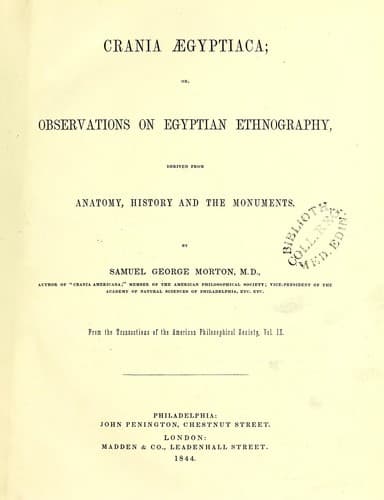
Crania Ægyptiaca: Or, Observations on Egyptian Ethnography Derived from Anatomy, History and the MonumentsMorton, Samuel George
History
Crania Ægyptiaca: Or, Observations on Egyptian Ethnography Derived from Anatomy, History and the Monuments
Morton, Samuel George
Craniology -- Egypt; Ethnology -- Egypt
In the midst of the vanquished Africans, seated in his car and urging
on the conflict, is Rameses himself; whose manly and beautiful
countenance will not suffer by comparison with the finest Caucasian
models. The annexed outline, (for all the figures are represented in
outline only,) will enable the reader to form his own conclusions
respecting this extraordinary group, which is believed to date about
fifteen hundred and seventy years before the Christian era.
[Illustration]
------------------------------------------------------------------------
9. THE MONGOLIANS.
It has been contended by Depauw, and others that the ancient Egyptians
were of the Mongolian race. I find nothing like Mongolian features in
any embalmed head in my collection, unless some general resemblance
can be traced in a solitary instance from Thebes, (Plate XII., Figs.
1, 2,) which, however, partakes more obviously of the Semitic form.
This observation sustains the opinion of Professor Blumenbach, who in
comparing the Egyptians with the several races of men, asserts, that
“they differ from none more than from the Mongolian, to which the
Chinese belong.”[118]
[Illustration]
That the Chinese had commercial intercourse with the Egyptians in very
early times, is beyond question; for vessels of Chinese porcelain,
with inscriptions in that language, have been repeatedly found in the
Theban catacombs.[119] Yet in every instance wherein we detect
Mongolians on the monuments, they are represented as foreigners and
enemies. The annexed wood-cut, with the small and somewhat depressed
nose, shaven head, and crown-lock, scanty beard, moustache, and sallow
complexion, seems clearly to indicate a man of that race. It is copied
from a drawing in Rosellini, in which Rameses the Third is represented
fighting against the _Sheto_ or Scythians, among whom the Mongols
appear to be allies or mercenaries.
------------------------------------------------------------------------
REMARKS.
Public-domain text, read in full here on John Shaqi.
Reviews
Reviews
No reviews yet
Be the first to share your thoughts on this work.
Elsewhere in the archive
Join the Discussion
Join the discussion
Sign in to leave a comment or review.
Sign InorCreate an account