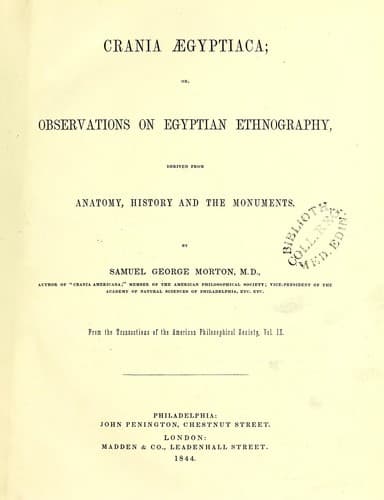
Crania Ægyptiaca: Or, Observations on Egyptian Ethnography Derived from Anatomy, History and the MonumentsMorton, Samuel George
History
Crania Ægyptiaca: Or, Observations on Egyptian Ethnography Derived from Anatomy, History and the Monuments
Morton, Samuel George
Craniology -- Egypt; Ethnology -- Egypt
Since the physical characteristics of the ancient Nilotic population,
as derived from history and the monuments, coincide in a remarkable
manner with the facts derived from anatomical comparison, it becomes
in the next place necessary to offer some explanation of these
results; or, to show at what periods and under what circumstances
several different branches of the Caucasian race were blended into a
single nation possessing more or less the characteristics of each, and
this again modified in degree by another race wholly different from
either. It is in the first place necessary to recur to the fact of the
very long occupation of Egypt by successive dynasties of Hykshos or
shepherd kings, and that these were not of one but of several
nations—Phenicians, Pelasgi, and Scythians; while to these followed,
at a long interval, an Ethiopian or Austral-Egyptian dynasty. Each of
these great revolutions must have tended in turn to the amalgamation
of the Egyptians with other nations; and this result may be referred
to three principal epochs, independently of several subordinate ones.
THE FIRST EPOCH embraces the dynasty of the Hykshos or shepherd kings,
commencing before Christ two thousand and eighty, and having a
duration of two hundred and sixty years.
It is important, however, to observe, that Josephus quoting Manetho,
makes the Hykshos dynasty last five hundred and eleven years; and the
learned Baron Bunsen, whose work has not yet appeared, extends it to
1000, beginning B.C. 2514.[120] The shorter period is that of
Rosellini; but the longer one is perhaps most consistent with facts,
and at least makes room for those various dominations which, in the
lists of Manetho, precede the eighteenth dynasty; which last, headed
by Amunoph the First, drove out the intrusive kings. During this long
period the legitimate sovereigns were exiled into Ethiopia; and it is
evident, that had Meroë been any other than a province or dependency
of Egypt, it is hardly probable that the Egyptians,—kings, priests,
and people,—could have found a safe asylum in that country during the
long period of their exile. It is expressly stated by Josephus that
the shepherd kings lived at Memphis, “and made both the upper and
lower country pay tribute.” It would appear, however, that during the
greater part of the Hykshos dynasty, the Egyptians retained possession
of the Thebaid: nevertheless the occupation of Lower Egypt by their
enemies, must have effectually precluded all communication with other
countries excepting Ethiopia, southern Arabia and India; which fact
will account for a vast influx of population from those countries,
(and consequently from the slave-regions of Africa) into the Upper
Nilotic provinces.
Public-domain text, read in full here on John Shaqi.
Reviews
Reviews
No reviews yet
Be the first to share your thoughts on this work.
Elsewhere in the archive
Join the Discussion
Join the discussion
Sign in to leave a comment or review.
Sign InorCreate an account