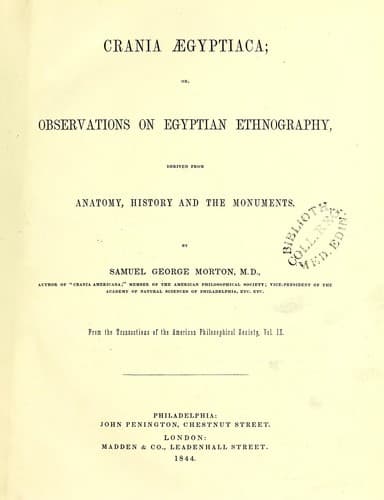
Crania Ægyptiaca: Or, Observations on Egyptian Ethnography Derived from Anatomy, History and the MonumentsMorton, Samuel George
History
Crania Ægyptiaca: Or, Observations on Egyptian Ethnography Derived from Anatomy, History and the Monuments
Morton, Samuel George
Craniology -- Egypt; Ethnology -- Egypt
10. The present Fellahs are the lineal and least-mixed descendants of
the ancient Egyptians; and the latter are collaterally represented by
the Tuaricks, Kabyles, Siwahs, and other remains of the Libyan family
of nations.
11. The modern Nubians, with a few exceptions, are not the descendants
of the monumental Ethiopians, but a variously mixed race of Arabs and
Negroes.
12. Whatever may have been the size of the _cartilaginous_ portion of
the ear, the osseous structure conforms in every instance to the usual
relative position.
13. The Teeth, differ in nothing from those of other Caucasian
nations.
14. The Hair of the Egyptians resembled, in texture, that of the
fairest Europeans of the present day.
15. The physical or organic characters which distinguish the several
races of men, are as old as the oldest records of our species.
* * * * *
NOTE.—I have taken frequent occasion to quote the opinions of the late
Professor Blumenbach, of Göttingen, whose name is inseparably
connected with the science of Ethnography; but I have to regret that
up to the present time I have not been able to procure either in this
country or from Europe, the last two memoirs which embrace his views
on Egyptian subjects, and especially the work entitled, “Specimen
historiæ naturalis antique artis operibus illustratæ.” His views,
however, as previously given to the world, have been repeatedly
adverted to in these pages; and his matured and latest observations,
as quoted by Dr. Wiseman, appear to have confirmed his original
sentiments. “In 1808,” says Dr. Wiseman, “he more clearly expressed
his opinion that the monuments prove the existence of _three distinct
forms_ or physiognomies among the ancient inhabitants of Egypt. Three
years later he entered more fully into this inquiry, and gave the
monuments, which he thought bore him out in this hypothesis. The first
of these _forms_ he considers to approach to the Negro model, the
second to the Hindoo, the third to the Berber, or ordinary Egyptian
head. (_Beträge zur Naturgeschichte_, 2 _ter Th._ 1811.) But I think
an unprejudiced observer will not easily follow him so far. The first
head has nothing in common with the _Black race_, but is only a
coarser representation of the Egyptian type; the second is only its
mythological or ideal purification.” _Lectures on the Connexion
between Science and Revealed Religion, 2d edit. p. 100._
Public-domain text, read in full here on John Shaqi.
Reviews
Reviews
No reviews yet
Be the first to share your thoughts on this work.
Elsewhere in the archive
Join the Discussion
Join the discussion
Sign in to leave a comment or review.
Sign InorCreate an account