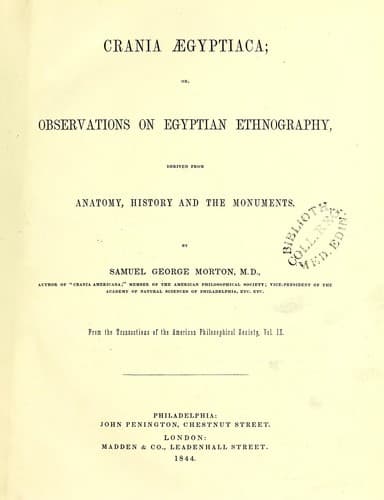
Crania Ægyptiaca: Or, Observations on Egyptian Ethnography Derived from Anatomy, History and the MonumentsMorton, Samuel George
History
Crania Ægyptiaca: Or, Observations on Egyptian Ethnography Derived from Anatomy, History and the Monuments
Morton, Samuel George
Craniology -- Egypt; Ethnology -- Egypt
those privileges which had once been sacred to particular castes. For
these and other oppressive acts, the Meröite kings were hated by the
Egyptians; and no sooner were they expelled than their names were
erased from the monuments.[123]
THE THIRD EPOCH dates from the conquest by Cambyses, B.C. 525, and
continues through the whole of the Persian dynasty, or, in other
words, until the Ptolemaic era, B. C. 332,—a period of nearly two
hundred years.
Every one knows that the Persian dominion in Egypt was marked by an
utter disregard of all the established institutions. No occasion was
omitted which could humble the pride or debase the character of the
people. The varied inhabitants of Europe, Asia and Nigritia poured
into the valley of the Nile, abolishing in degree the exclusiveness of
caste, and involving an endless confusion of races.
The prelude to these changes and misfortunes can be traced to the
reign of Psammeticus the First, who permitted to foreigners, and
especially to the Greeks, a freedom of ingress which the laws and
usages of the country had previously denied them. The same policy
appears to have been fostered by the subsequent kings of the same
dynasty, until its consummation by Amasis; (B.C. 569) when, in the
language of Champollion-Figéac, Egypt became at once Egyptian, Greek,
and Asiatic; her national character was lost for ever; her armies were
filled with foreign mercenaries; the throne was guarded by European
soldiers, and continual wars completed the destruction of a tottering
kingdom.[124]
------------------
CONCLUSIONS.
1. The valley of the Nile, both in Egypt and in Nubia, was originally
peopled by a branch of the Caucasian race.
2. These primeval people, since called Egyptians, were the Mizraimites
of Scripture, the posterity of Ham, and directly affiliated with the
Libyan family of nations.
3. In their physical character the Egyptians were intermediate between
the Indo-European and Semitic races.
4. The Austral-Egyptian or Meröite communities were an Indo-Arabian
stock engrafted on the primitive Libyan inhabitants.
5. Besides these exotic sources of population, the Egyptian race was
at different periods modified by the influx of the Caucasian nations
of Asia and Europe,—Pelasgi, or Hellenes, Scythians and Phenicians.
6. Kings of Egypt appear to have been incidentally derived from each
of the above nations.
7. The Copts, in part at least, are a mixture of the Caucasian and the
Negro in extremely variable proportions.
8. Negroes were numerous in Egypt, but their social position in
ancient times was the same that it now is, that of servants and
slaves.
9. The national characteristics of all these families of Man are
distinctly figured on the monuments; and all of them, excepting the
Scythians and Phenicians, have been identified in the catacombs.
Public-domain text, read in full here on John Shaqi.
Reviews
Reviews
No reviews yet
Be the first to share your thoughts on this work.
Elsewhere in the archive
Join the Discussion
Join the discussion
Sign in to leave a comment or review.
Sign InorCreate an account